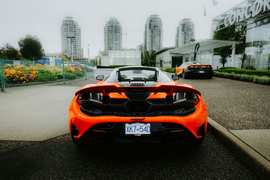
Pagani Utopia: The Pinnacle of Hypercar Alchemy in 2025
For over a quarter of a century, the name Pagani has been synonymous with automotive artistry, a whispered promise of mechanical poetry crafted from the finest materials and infused with an almost divine passion. Now, in 2025, Horacio Pagani’s latest masterpiece, the Utopia, arrives not just as a successor to the legendary Huayra, but as a profound redefinition of the hypercar ethos. This isn’t merely a car; it’s a statement, a philosophical exploration of what happens when obsessive engineering meets unbridled artistry.
As a seasoned observer of the Pagani Utopia review landscape, having spent a decade immersed in the world of high-performance automotive journalism and analysis, I can attest that the arrival of a new Pagani model is an event of seismic proportions. The Zonda, the Huayra, and now the Utopia – each represents a distinct chapter in automotive history, a testament to a singular vision that prioritizes soul over mere speed, and exquisite detail over fleeting trends. The Pagani Utopia price of £2.2 million signifies more than just exclusivity; it reflects an investment in a legacy, a commitment to a craft that few can comprehend, let alone replicate.
The core of the Utopia’s magic lies in its unapologetic celebration of mechanical purity. In an era increasingly dominated by electrification and autonomous driving, the Utopia stands as a defiant bastion of the analog experience. Its heart beats with a magnificent 6.0-liter twin-turbo V12 engine, hand-built by AMG, producing a colossal 852 horsepower and a staggering 811 lb-ft of torque. This isn’t just raw power; it’s a symphony of controlled fury, a visceral eruption of acceleration that redefines the very concept of hypercar performance.
Imagine this: you’re cruising at a modest 30 mph in third gear. You gently depress the throttle, and for a fleeting moment, there’s a palpable anticipation. Then, the V12 awakens. It doesn’t just accelerate; it ignites. The world blurs at the edges, not with the jarring brutality of an electric surge, but with a relentless, ever-intensifying pressure that presses you back into the exquisitely crafted carbon-fiber seat. It’s an embrace of longitudinal G-forces that is both exhilarating and utterly addictive. The initial shock gives way to a primal thrill, a childlike wonder that compels you to repeat the experience, again and again. This is the elemental appeal of the Utopia, a machine that reminds us of the sheer, unadulterated joy of driving.
The genesis of the Utopia’s name is as profound as its engineering. Sir Thomas More’s seminal work, “Utopia,” envisioned a perfect society. Horacio Pagani, in his own artistic and engineering dialect, has created a perfect machine. This isn’t hyperbole; it’s a sober assessment of a vehicle that transcends mere automotive engineering. Weighing in at a featherlight 1280kg (dry weight), the Utopia is a marvel of advanced composites and exotic alloys, a testament to Pagani’s unparalleled mastery of materials science. The exclusivity is, of course, paramount; only 99 examples of the coupe version will be produced, with a select few opting for the equally breathtaking Roadster variant. For the fortunate few who secure one, it represents a gateway into an rarefied realm of automotive appreciation.
Pagani cars are not produced in mass quantities. The Utopia represents only the third distinct model line to emerge from Pagani’s San Cesario sul Panaro factory in over two decades. This patient, deliberate approach to creation is what imbues each Pagani with its unparalleled character and enduring appeal. It’s a process akin to commissioning a Renaissance masterpiece – you wait, you anticipate, and when it arrives, it utterly surpasses all expectations.
The Pagani experience, as I’ve witnessed throughout my career, is a journey. My own introduction to the Utopia began not in the driver’s seat, but in the passenger’s, alongside Pagani’s R&D test driver, Alberto Scilla. This initial immersion is crucial for any automotive expert evaluating a vehicle of this caliber. It allows for an objective assessment of the car’s behavior, its intrinsic qualities, before the emotions of driving take over.
Our destination: the fabled Futa Pass, a legendary stretch of asphalt just 90 minutes from Pagani’s headquarters, a route steeped in the history of the Mille Miglia. This iconic setting provides the perfect backdrop to experience the Utopia’s nuanced character, a place where its breathtaking performance can be explored without attracting undue attention – a near impossibility for a car that commands such immediate and universal admiration.
From the passenger seat, the Utopia’s inherent qualities shone through. It possessed a surprising suppleness, a refinement that belied its ferocious potential. The V12, even at lower speeds and with gentle throttle inputs, remained a subtle, powerful presence, a sleeping giant ready to awaken. Pagani has always prioritized the driving experience on public roads, and the Utopia elevates this principle to new heights, seamlessly blending exceptional refinement with mouth-drying performance. This focus on the Pagani Utopia driving experience is a hallmark of the brand.
Alberto’s insights into the development of the manual transmission were particularly illuminating. The challenge of mating an 811 lb-ft torque monster to a traditional stick shift, while maintaining delicate clutch feel and crisp gear changes, is immense. Yet, judging by Alberto’s effortless manipulations of the gear lever, Pagani has not only met this challenge but has conquered it. The Utopia’s manual gearbox is a masterclass in engineering precision, a vital component in its celebration of manual hypercar engagement.
As we flowed along the autostrada, cutting through traffic with effortless grace, the Utopia exuded an aura of predatory elegance. The V12 would occasionally sigh, a rich, guttural growl erupting from the depths of its six liters as Alberto’s throttle inputs became more assertive. It’s a sound that is more nuanced, more outgoing than the Huayra’s, yet possesses a sharper, more steely edge – a testament to the continuous evolution of this iconic powerplant.
Our stop for fuel provided a moment of communal awe. Even in the quiet Italian countryside, the Utopia drew people from seemingly nowhere, their faces illuminated by the glow of their smartphones, eager to capture a glimpse of this automotive marvel. It’s a testament to the car’s magnetic aesthetic, a design that shuns overt aggression for a more artistic pursuit. The absence of massive wings and exaggerated aero elements underscores Pagani’s commitment to form and purity, embellished with intricate details and captivating flourishes. This is the essence of Pagani Utopia design, a fusion of art and engineering that is uniquely its own.
Holding the solid, Utopia-shaped key fob felt like possessing a piece of finely crafted jewelry. My gaze, however, was inevitably drawn to the car’s sculptural lines, its compound curves that spoke of meticulous attention to detail. Every piece of brightwork, machined from a solid billet, gleamed with a jewel-like quality, reinforcing the illusion that the entire car had been sculpted from a single, monolithic form.
The upswept dihedral doors, a signature Pagani flourish, opened to reveal a cockpit that is nothing short of a maximalist masterpiece. It’s an interior that assaults the senses in the most delightful way, a riot of exquisite materials, shapes, and finishes. Familiar Pagani cues are present: the periscope air vents, the floating crescent instrument binnacle, the exposed carbon fiber structure, and the innovative use of glazing that extends into the roof, bathing the cabin in light and creating an expansive sense of space.
The Utopia’s commitment to mechanical artistry is most vividly expressed in its analog instruments. Each gauge features small portholes, offering a glimpse into the intricate workings of its Swiss-watch-like mechanisms. And then there is the gear shifter, a sculpture in itself, rising from the transmission tunnel, its complex linkage proudly displayed. This is a direct homage to Leonardo da Vinci’s philosophy, a belief in the inseparability of art and science, a principle that permeates every facet of Pagani’s creations. The steering wheel, a prime example, begins as a 43kg billet of high-grade alloy, subjected to 28 hours of five-axis machining to tolerances of just 0.5 microns, then meticulously hand-polished to a mere 1.6kg. The 41.3kg of leftover material is, naturally, recycled – a testament to Pagani’s commitment to sustainability.
The manual clutch pedal, often a source of complaint in other supercars, is remarkably light and smooth in the Utopia. It requires just enough effort to feel mechanical, and finding the bite point is an intuitive, delightful process. The gear shifter itself is clean and precise, its gate delightfully open, with a positive spring bias that guides the lever with satisfying accuracy. It’s no surprise that 70% of Utopia customers have opted for the manual transmission; it is the heart of the Pagani Utopia manual gearbox appeal. The inclusion of a dog-leg first gear further enhances the nostalgic charm, though the V12’s prodigious torque means a second-gear start is entirely feasible.
While the Utopia proudly embraces its analog roots, it is far from technologically deficient. A selection of dynamic modes – Comfort, Sport, Race, and Wet – allows drivers to tailor the car’s demeanor. The Supersoft mode, akin to Ferrari’s bumpy road button, provides immediate access to the most compliant suspension setting. However, the TracTive semi-active dampers are so expertly calibrated that this setting is rarely needed. Sport mode strikes the perfect balance, injecting a shot of adrenaline into the Utopia’s system without overwhelming it. The ESC offers reassuring oversight, subtly intervening when overzealous throttle application threatens to unsettle the car, allowing for blistering progress on even the most challenging roads, especially when paired with the exceptional Pirelli P Zero Corsa tires.
The temptation to switch to Race mode is ever-present, a siren call to unleash the Utopia’s full fury. The internal dialogue between caution and exhilaration is a familiar one for anyone privileged enough to pilot such a machine. Ultimately, a compromise is struck: Race mode engaged, but the ESC left firmly in place. This decision proves wise. Race mode unlocks the Utopia’s latent performance, while the more relaxed ESC allows for a controlled, exhilarating degree of rear-wheel slip, ensuring a dependable safety net.
Accelerating through the gears in the Utopia is akin to piloting a rocket. The AMG-designed V12, while not a high-revving screamer (its redline is a modest 6700rpm), delivers each gear with profound satisfaction. Third and fourth gears become your favored companions, with occasional excursions into fifth and judicious downshifts to second. In Race mode, the V12’s roar becomes more guttural, punctuated by thrilling induction chuffs and turbo whistles as you modulate the throttle. The overrun is equally dramatic, with a bass-heavy artillery barrage emanating from the Gatling-gun exhaust.
This raw, explosive power stands in stark contrast to the Utopia’s seductive form and refined character. Yet, its precision, poise, and illusion of compactness are utterly contemporary. Unlike older supercars that wore their heft like a badge of honor, the Utopia, much like the hybrid Lamborghini Revuelto, has embraced the modern paradigm of agility and responsiveness. Pagani’s inherent advantage lies in its construction: a chassis of titanium-infused carbon fiber and a mechanical purity that negates the need for complex electronic solutions to mitigate mass.
Power-to-weight ratios, while numerically impressive, can be misleading. The Utopia, with its 1280kg dry weight and 852bhp, might be outgunned in a straight line by electric hypercars like the Pininfarina Battista or the Bugatti Chiron. However, its significantly lower mass translates into a palpable sense of alertness and energy. It feels more dynamic, more immediate, requiring less effort to propel, contain, and maneuver.
On the sinuous curves of the Futa Pass, this translates into colossal potency between corners, coupled with an uncanny ability to revel in braking zones and apexes. The Utopia feels natural, predictable, and even exploitable, encouraging a deeper exploration of its prodigious performance reserves. The steering is light and precise, possessing a quickness that allows for accurate apex targeting, yet with a calmness that inspires unwavering confidence. The ability to place the inside front wheel with such uncanny accuracy is a revelation. Initially, one might crave a fraction more tactile feedback, but with time, it becomes clear that this lack of distraction is a deliberate design choice. Combined with the light clutch, effortless gear shifts, and titanic powerplant, the Utopia fosters a sense of harmony, not conflict, between driver and machine.
The same seamless integration is evident when engaging the massive 410mm front and 390mm rear Brembo CCM-R brakes. The colossal six-piston front and four-piston rear calipers exert progressive clamping force on the vast carbon rotors. These brakes are remarkably easy to modulate at low speeds, offering immense, confidence-inspiring bite at higher velocities, all with a consistently firm pedal.
The magic of the Pagani Utopia lies in its ability to transcend conventional hypercar doctrine. It is undeniably powerful and breathtakingly fast, but its true genius lies in its pursuit of perfect harmony. The marriage of the monumental biturbo V12 to the sweet-shifting manual gearbox is transformative. By eschewing the pursuit of four-digit horsepower or stratospheric redlines, Pagani has created a powertrain that delivers eye-widening, yet crucially, nuanced performance that excels on the road at all speeds. Its ability to meet global emissions and homologation standards is a testament to Pagani’s meticulous approach and the invaluable partnership with AMG.
Sophisticated electronics, often seen as antithetical to the analog driving experience, are masterfully employed in the Utopia. The deft application of adaptive damping, ESC, and the electronic differential finesses the car, enhancing the feel and dynamism that discerning drivers crave.
The result is a savagely quick and sublimely sorted machine. It combines the purity and engagement of the Zonda with the epic reach and modern refinements of the Huayra, all while imbuing it with its own authentic character and distinct capabilities. The Utopia moves the game forward, yet adheres to its own timeless principles. It is contemporary where it counts, and timeless where it matters. Pagani has, once again, achieved the seemingly impossible.
For those who crave the open-air experience, the Pagani Utopia Roadster presents an equally compelling proposition. Unlike previous Roadster iterations, the Utopia’s coupe and Roadster designs were developed concurrently, resulting in a vehicle with even fewer compromises. The dry weight remains an identical 1280kg, a testament to Pagani’s unparalleled expertise in carbon fiber construction, allowing the bespoke tub to retain exceptional rigidity without the need for additional reinforcement. Like its coupe sibling, the Utopia Roadster boasts worldwide homologation for safety and emissions. Production numbers and pricing have seen a slight increase, with the Roadster commanding a price of £3.1 million for each of the 130 examples slated for production, at a rate of approximately 50 to 60 cars per year.
The Pagani Utopia is more than just a car; it is an experience, a testament to a philosophy of automotive excellence that prioritizes soul, artistry, and an unyielding commitment to the perfect driving machine. It invites you to explore the outer limits of performance, not through brute force alone, but through a profound connection between driver, machine, and the road itself.
Are you ready to experience the pinnacle of hypercar artistry? Contact your authorized Pagani representative today to learn more about securing your piece of automotive history and embark on the ultimate driving journey.