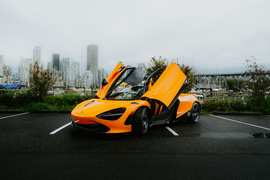
Pagani Utopia 2025: Redefining the Hypercar Paradigm with Unrivaled Craftsmanship and Driving Purity
For over a quarter-century, the name Pagani has been synonymous with automotive artistry, a beacon of extreme performance blended with unparalleled mechanical sculpture. Each creation from Horacio Pagani’s atelier is more than just a car; it’s a meticulously crafted symphony of art, science, and raw, unadulterated exhilaration. Now, the marque introduces its third distinct model line, the Pagani Utopia 2025, a successor to the legendary Huayra, promising to elevate the hypercar experience to an entirely new stratum. This isn’t merely an evolution; it’s a profound statement about what a modern hypercar should be, eschewing fleeting trends for enduring principles.
With an RRP starting from a staggering £2,200,000, the Utopia is an exclusive proposition, designed for a discerning clientele of 99 coupe and 130 Roadster customers who understand that true automotive excellence transcends mere speed. It represents a tangible embodiment of perfection, a stark contrast to the philosophical concept of Utopia envisioned centuries ago. While Sir Thomas More’s vision remained an impossible ideal, the Pagani Utopia is a real, breathing testament to human ingenuity and passion, a machine that captures the imagination and ignites the soul.
As an industry professional with a decade immersed in the world of performance automotive, I’ve witnessed firsthand the relentless march of technology, particularly the burgeoning influence of electrification. Yet, the Utopia stands as a bold, defiant affirmation of the internal combustion engine’s enduring magic, specifically the magnificent twin-turbo V12 sourced from AMG. This isn’t a nostalgic nod to the past; it’s a deliberate, calculated embrace of a driving experience that offers a visceral connection to the road, a connection that many electrified alternatives struggle to replicate.
The Elemental Allure of Torque: A Symphony of Force
The true essence of the Utopia’s appeal lies in its immediate, visceral response to driver input. Imagine cruising at a sedate 30 mph in third or fourth gear. With a subtle flex of your fingers around the exquisitely crafted steering wheel and a deep breath, you command the 6-liter, twin-turbo V12. The initial response is a fleeting, almost imperceptible hesitation, a moment where the colossal 852 horsepower and 811 lb-ft of torque gather their breath. Then, the transformation begins. The air itself seems to liquefy into explosive kinetic energy. The experience is less about the brutal, disorienting slam often associated with extreme electric acceleration and more about an intensifying, ever-building pressure that presses you firmly back into your seat.
The initial surge is so potent that it triggers an almost primal, involuntary reaction – a bodily recoil akin to balancing precariously on a chair. A quick lift of the throttle, a moment to compose oneself, and the lingering scent of adrenaline is quickly followed by a wave of pure, unadulterated joy. And then, inevitably, the desire to repeat the experience. Again and again. The Utopia’s ability to propel you forward with such relentless force, like a bungee jump towards the horizon, is a novelty that never fades. While such straight-line acceleration might seem a simplistic measure of its capabilities, it perfectly encapsulates the elemental, captivating allure of this extraordinary machine. This is the core of the Pagani Utopia 2025 experience – raw, unadulterated torque delivered with artistic finesse.
A Legacy of Excellence: From Zonda to Utopia
The Pagani Utopia isn’t born from a vacuum. It is the culmination of over 25 years of relentless pursuit of perfection, building upon the legendary foundations laid by the Zonda and the Huayra. The journey began in 1999, with a young Pagani atelier housed in a modest glass and steel structure, which now serves as its Art & Science Research Centre. Today, the company operates from an impressive ‘Atelier’ in San Cesario sul Panaro, a facility opened in 2017, encompassing production, restoration, personalization, and special projects, embodying the brand’s evolution and growth.
This is only the third distinct model line in Pagani’s history, a testament to the brand’s meticulous approach to development. Each new model is an event, a culmination of countless hours of design, engineering, and testing. The wait for the Utopia has been significant, but as anyone familiar with Pagani’s work will attest, it has been unequivocally worth it.
My introduction to the Utopia began not behind the wheel, but in the passenger seat, riding shotgun with Pagani’s R&D test driver, Alberto Scilla. While I typically prefer an active role, this shared experience offered a unique perspective, allowing me to gauge the car’s behavior and responsiveness before taking the helm. Our destination: the Futa Pass, a legendary stretch of road steeped in Mille Miglia history, just 90 minutes from Pagani’s headquarters. This iconic route provides the perfect backdrop to experience the Utopia, away from the prying eyes of casual onlookers, allowing for a more intimate engagement with its capabilities.
Even from the passenger seat, the Utopia is a revelation. It possesses a suppleness that belies its hypercar credentials, and while the V12 is ever-present, it remains remarkably unobtrusive at lower speeds and with gentle throttle inputs. However, when called upon, its immense power is unleashed with a thrilling, almost intimidating authority. This duality – the ability to be a docile companion one moment and a ferocious predator the next – is a hallmark of Pagani’s road-car philosophy, now elevated to new heights of refinement.
Scilla’s insights into the development of the manual transmission were particularly illuminating. He spoke of the painstaking efforts to achieve not only precise shift quality but also an exceptionally tactile clutch feel. Managing over 811 lb-ft of torque through a traditional manual gearbox is a monumental engineering challenge, yet the Utopia achieves a delicacy that truly celebrates the art of stick-shift driving. The way Scilla effortlessly navigated through the gears, even at speed, was a clear indication of the success of this endeavor.
Cruising along the autostrada, the Utopia glided through traffic with an effortless presence, a veritable apex predator amongst mere mortals. The V12’s subtle growl, punctuated by brief throttle applications, hinted at the storm brewing beneath the surface. It’s a more refined, perhaps even more personable delivery than the Huayra’s, possessing a richer, more outgoing character, yet underscored by a sharper, steelier edge. This engine is, quite simply, a masterpiece.
An Aesthetic Masterpiece: Artistry in Motion
Our first stop for refuelling provided an opportunity to witness the Utopia’s magnetic pull. As if summoned by its presence, people emerged from nowhere, drawn by its undeniable charisma. While this might seem intrusive, there’s a profound reassurance in the enduring allure of such a visually stunning machine. It’s a testament to Pagani’s ability to create not just cars, but objects of desire.
Stepping back, even after an hour in its presence, I found myself captivated by the Utopia’s form. Eschewing the overt aerodynamic appendages and aggressive diffusers often seen on modern hypercars, the Utopia embraces a more artistic philosophy. Its design prioritizes purity of form, embellished with lavish details and captivating flourishes. This unique fusion is the very essence of Pagani’s distinctive aesthetic, a visual dialogue between art and engineering.
The coveted Utopia-shaped key, cool and weighty in my hand, did little to temper the mesmerized gaze I cast upon its sculpted lines. Every piece of exterior and interior brightwork is machined from solid billet, bestowing a jewelry-like quality and creating the illusion that the entire car has been hewn from a single, monolithic entity. Seeing it in the ‘wild’ is a truly remarkable experience.
The Interior: A Sanctuary of Mechanical Artistry
The upswept dihedral doors, a signature of modern supercars and a departure from the Huayra’s gullwings and the Zonda’s conventional hinges, open to reveal an extraordinary cockpit. It’s a dazzling exercise in maximalism, a riot of exquisite materials, intricate shapes, and diverse finishes. Familiar Pagani cues are present: the periscope air vents, the floating crescent instrument binnacle, the flawless exposed carbonfibre structure, and the clever integration of glazing, extending into the roof to flood the cabin with light and a sense of spaciousness.
True to its ethos, the Utopia celebrates the beauty of mechanical components. The analogue instruments feature small portholes, allowing a glimpse of their intricate workings, much like the movement of a fine Swiss watch. And then there’s the gear shifter. Rising from the transmission tunnel like a sculpted artifact, this seven-speed manual transmission’s shift lever is machined from solid metal, its complex linkage proudly displayed for all to admire.
Pagani’s profound admiration for Leonardo da Vinci, who championed the inseparable link between art and science, is evident throughout the Utopia. The steering wheel serves as a prime example. Crafted in Modena Design’s advanced CNC facility, it begins as a 43kg billet of high-grade alloy. After 28 hours of five-axis machining to tolerances of just 0.5 microns, followed by meticulous hand-polishing, the finished wheel weighs a mere 1.6kg. The impressive 41.3kg of leftover swarf is then responsibly recycled, a nod to sustainability amidst such opulence.
The Driving Experience: A Human-Machine Harmony
The manual clutch pedal, often a source of fatigue in less refined supercars, is surprisingly light and smooth in the Utopia. There’s just enough resistance to provide a satisfying mechanical feel, and finding the bite point for a seamless pull-away is a delightful affair. The gear shifts are clean and precise, perhaps a fraction longer than some might expect, lacking the pronounced resistance of a gated Ferrari shift, but undeniably pleasing.
A dog-leg first gear adds a touch of nostalgic charm, though the abundance of torque from tickover often renders it unnecessary for pulling away. However, the positive spring bias guiding the lever towards the center line of the open gate makes the upshift to second and subsequent gears remarkably slick. It’s no surprise that a significant 70% of Utopia customers opt for the manual transmission; it is the purist’s choice.
Despite its proudly analogue aesthetic, the Utopia is equipped with sophisticated, fully integrated electronics. A selection of dynamic modes – Comfort, Sport, Race, and Wet – allows for fine-tuning the car’s demeanor. A ‘Supersoft’ mode, akin to a Ferrari’s bumpy road setting, provides immediate access to the most compliant suspension.
In reality, this mode is rarely needed. The semi-active TracTive dampers are expertly calibrated, offering an impressive balance between bump absorption and body control. My preferred setting is Sport, which injects a lively energy into the Utopia without making it overly edgy. The Electronic Stability Control (ESC) provides reassuring oversight, subtly intervening to curb enthusiastic throttle application on corner exits, allowing for blistering progress. This is further enhanced by the Pirelli P Zero Corsa tires – 265/35 R21 at the front and 325/30 R22 at the rear – which, once warmed, offer immense grip.
The temptation to switch to Race mode is always present, tempered by the rather daunting prospect of explaining any damage to Horacio Pagani’s £2.2 million masterpiece. The internal dialogue between self-preservation and the allure of ultimate performance is a familiar one for anyone privileged enough to pilot such a machine. Ultimately, a compromise is reached: Race mode is engaged, but the ESC remains firmly untouched. This proves to be the correct decision. Race mode unlocks the Utopia’s full performance potential, while the more relaxed ESC allows for a controlled, enjoyable degree of rear-wheel oversteer, with dependable intervention when necessary.
Unleashing the Utopia through the gears is akin to riding a rocket. The AMG-designed, hand-built Pagani V12, while not a high-revving screamer with a redline of 6700rpm, delivers its power in a way that makes each gear shift an event to be savored. Third and fourth gears become familiar companions, with occasional forays into fifth and downshifts to second. In Race mode, the V12’s roar intensifies, becoming harder and more guttural, accompanied by a delightful symphony of induction chuffs and turbo whistles as the throttle is modulated. The exhilaration extends to off-throttle moments, with a deep, bass-heavy artillery barrage erupting from the Gatling-gun exhaust on the overrun.
This raw, explosive power, juxtaposed with the Utopia’s elegant form and refined character, is astounding. Yet, its precision, poise, and deceptive compactness are utterly contemporary. While older supercars often wore their size and weight like a badge of honor, the latest generation, exemplified by the hybrid Lamborghini Revuelto with its torque vectoring, has redefined expectations. Paganis have always possessed a genetic advantage: chassis built from titanium-infused carbon fibre and a mechanical purity that eliminates the need for complex systems to manage mass. Despite its timeless objectives, the Utopia has demonstrably moved with the times.
Power-to-weight ratios can be misleading. A 500bhp car weighing a ton might seem numerically equivalent to a two-ton car with 1000bhp, but the driving experience is worlds apart. The Utopia, with its 1280kg dry weight (1340kg wet) and 852bhp, feels remarkably energized and alert at all times. While hyper-EVs like the Pininfarina Battista or Bugatti Chiron may boast higher peak figures, the Utopia’s comparatively lower mass translates into a more agile and engaging drive, requiring less effort to accelerate, decelerate, and change direction.
On the more challenging sections of the Futa Pass, this translates into colossal potency between corners, a car that revels in braking zones and thrives in the turns themselves. It feels natural, predictable, and remarkably exploitable, encouraging the driver to delve deeper into its prodigious performance reserves. The steering is light and precise, offering sharp reflexes without sacrificing composure, allowing for accurate and confident placement of the car. The ability to position the inside front wheel with uncanny accuracy is a highlight. Initially, one might crave a fraction more feedback, but with experience, it becomes clear that this deliberate lack of distraction is an integral part of the Utopia’s design philosophy. Combined with the light clutch, smooth gearbox, and titanic powerplant, the experience is one of effortless harmony rather than a battle against the machine.
The same sentiment applies to the immense 410mm front and 390mm rear Brembo CCM-R brakes. The substantial six-piston front and four-piston rear calipers apply progressive clamping force to the vast carbon rotors, offering effortless modulation at lower speeds and relentless bite at higher velocities, all with a consistently firm pedal that instills unwavering confidence.
The Utopia Verdict: Harmony Over Extremes
The Pagani Utopia is an exquisite and eccentric masterpiece that transcends conventional hypercar dogma. Yes, it is immensely powerful and breathtakingly fast, but as its name suggests, the Utopia’s true emphasis lies in delivering perfect harmony in all aspects of its being, rather than prioritizing extreme performance at the expense of the overall experience. The marriage of the monumental biturbo V12 to a beautifully executed manual gearbox is nothing short of transformative. Similarly, the decision to eschew four-digit horsepower figures or stratospheric redlines has resulted in a powertrain that delivers eye-widening, and crucially, nuanced performance that is brilliant on the road at all speeds. The fact that it meets global emissions and homologation standards further underscores Pagani’s meticulous approach to its craft and the invaluable partnership with AMG as its engine supplier.
While sophisticated electronics might seem antithetical to an organic, analogue driving experience, the deft application of adaptive damping, ESC, and the electronic differential successfully refines and, when necessary, tames the Utopia, enhancing the feel and dynamism that discerning drivers crave.
The result is a savagely quick and sublimely sorted automobile. It combines the purity and engagement of the Zonda with the epic reach and modern refinements of the Huayra, all while forging its own authentic character and distinct capabilities. The Utopia moves the game forward by adhering to its own immutable rules; it is contemporary where it counts, and timeless where it truly matters. Horacio Pagani has, once again, achieved the seemingly impossible.
The Pagani Utopia Roadster: An Uncompromised Open-Air Experience
Pagani’s legacy includes iconic open-top versions of both the Zonda and Huayra. However, the Utopia marks a significant evolution, as the design process for the coupe and Roadster versions was conducted concurrently. This parallel development has resulted in a car with even fewer compromises. The dry weight remains an identical 1280kg, a testament to Pagani’s mastery of carbonfibre, with the bespoke tub retaining exceptional rigidity without the need for additional reinforcement. Like its coupe sibling, the Utopia Roadster benefits from worldwide homologation for safety and emissions.
While the engineering remains remarkably consistent, build numbers and price have seen an increase. Pagani is asking £3.1 million for each of the 130 Roadsters to be produced, at a rate of approximately 50 to 60 cars per year.
The Pagani Utopia represents more than just a new hypercar; it’s a profound statement on the enduring allure of mechanical artistry and the ultimate driving experience. It’s a car that invites you to engage, to connect, and to savor every single moment behind the wheel.
Are you ready to explore the ultimate expression of automotive art and engineering? Contact your authorized Pagani dealer today to learn more about the extraordinary Pagani Utopia 2025 and begin your journey into a realm of unparalleled driving pleasure.