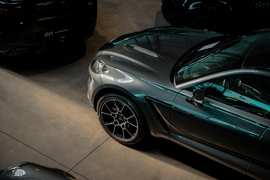
Pagani Utopia: A Symphony of Power, Precision, and Unrivaled Craftsmanship
For over a quarter-century, the name Pagani has been synonymous with automotive artistry, a brand that transcends mere engineering to deliver soul-stirring mechanical masterpieces. Now, with the unveiling of the Pagani Utopia, Horacio Pagani’s vision of the ultimate hypercar reaches an exhilarating new zenith. Succeeding the legendary Huayra, the Utopia isn’t just an evolution; it’s a profound statement on what a hypercar should be in the modern era, a meticulous fusion of relentless performance, exquisite detailing, and a driving experience that can only be described as profoundly visceral. This isn’t just a car; it’s an experience, a testament to the enduring allure of internal combustion in a world increasingly embracing electrification.
As an industry veteran with a decade immersed in the world of high-performance automobiles, I’ve witnessed firsthand the relentless march of technology, the pursuit of ever-increasing horsepower, and the growing dominance of electric powertrains in the hypercar segment. Yet, the Pagani Utopia emerges as a breathtaking counterpoint, a defiant celebration of mechanical purity and artisanal craftsmanship. At a starting price of £2,200,000, the Utopia occupies a rarefied stratum, accessible only to a select few. This is not a car for the masses, nor is it a car that seeks to be. It is a meticulously crafted object d’art, designed for those who appreciate the sublime intersection of engineering prowess and artistic expression.
The core of the Utopia’s allure lies in its powertrain. Displacing a formidable 6 liters, the twin-turbocharged V12 engine, meticulously engineered by AMG, produces a staggering 852 horsepower and a colossal 811 lb-ft of torque. This is not the sterile, instantaneous thrust of an electric motor. Instead, the Utopia offers a dramatic, unfolding surge of power that engages the senses in a way that only a finely tuned internal combustion engine can. Experiencing this power firsthand is a revelation. In the lower gears, at moderate speeds, a gentle application of the throttle unleashes a tidal wave of torque. The slightest pressure builds an ever-intensifying longitudinal g-force, a relentless squeeze that pins you back into your seat. It’s an experience that elicits an involuntary intake of breath, a moment of primal exhilaration followed by an irrepressible grin. This is the very essence of hypercar performance, a raw and elemental joy that the Utopia delivers in spades.
Beyond the sheer force, the Utopia’s brilliance lies in its nuanced delivery. Unlike the often-unpleasant jolt of some extreme EVs, the Pagani’s surge is an intoxicating, ever-intensifying embrace. It’s the kind of power that makes you want to repeat the experience, to push the boundaries of physics and your own perception. This inherent appeal, the sheer ability of the Utopia to propel you towards the horizon with such unadulterated force, is a testament to its elemental charm, a quality that never seems to diminish, even after repeated encounters. While seemingly simple, these in-gear accelerations highlight the profound capabilities of this exquisite and extraordinary machine.
The very name, “Utopia,” conjures images of an idealized state, a vision of perfection. While Sir Thomas More’s philosophical treatise explored societal ideals, Horacio Pagani’s interpretation is tangible, a £2,200,000, 1280kg marvel of advanced composites and exotic alloys, powered by that glorious V12. It’s a dream realized, a testament to Pagani’s unwavering commitment to his craft. For the fortunate 99 individuals who secured a coupe build slot, and potentially for those opting for the Roadster, this dream is a reality. For the rest of us, it remains a fleeting, vicarious experience, best savored on the world’s most exquisite roads, in close proximity to the Pagani atelier in San Cesario sul Panaro.
The arrival of a new Pagani model is an event of profound significance. In over 26 years, Utopia marks only the third distinct model line to emerge from the company’s hallowed halls, following the iconic Zonda and the groundbreaking Huayra. The anticipation surrounding its debut was palpable, and the question on everyone’s lips: has the wait been worth it? The answer, unequivocally, is yes.
Since my initial visit to Pagani in 1999, the company has undergone a remarkable transformation. From a modest workshop housed within Horacio Pagani’s residence, the brand has blossomed into a global icon. The current headquarters, the “Atelier,” inaugurated in 2017, is a testament to this growth, a stunning fusion of museum, production facility, and creative hub. It’s here that the specialized departments—Rinascimento for restorations, Unico for bespoke commissions, and Grandi Complicazioni for ultra-limited projects—thrive. The Utopia is the culmination of this evolution, a product of unparalleled expertise and unwavering passion.
My introduction to the Utopia began not behind the wheel, but in the passenger seat, alongside Pagani’s experienced R&D test driver, Alberto Scilla. While I typically prefer an active role, this was an invaluable opportunity to observe the Utopia’s character and performance before taking the reins. Our destination: the fabled Futa Pass, a mere 90 minutes from the factory, steeped in Mille Miglia history, and the perfect stage for a discreet yet exhilarating encounter with the Utopia. Even from this vantage point, the experience was captivating. The ride was surprisingly supple, and the V12, while ever-present, remained unobtrusive at lower speeds, its might only revealed when truly roused. This duality—refined comfort alongside earth-shattering performance—is a hallmark of Pagani’s road-car ethos, elevated to unprecedented levels in the Utopia.
Scilla’s commentary highlighted the immense effort invested in perfecting the manual transmission. In an era where manual gearboxes are increasingly scarce, especially in hypercars boasting such prodigious torque, the Utopia’s seven-speed unit is a triumph. The precision of the shifts, the tactile feel of the clutch, and the seamless engagement are nothing short of remarkable. The way Scilla navigated the gears, executing downshifts with flawless precision, was a masterclass in mechanical engagement. It’s no surprise that a significant percentage of Utopia customers opt for the manual, seeking that purist connection to the machine.
Cruising along the autostrada, the Utopia cuts an imposing figure, a predatory presence that commands attention. As Scilla occasionally drops a gear and applies a modest amount of throttle, the V12 awakens with a guttural growl, a symphony of hisses and roars as the turbos spool. This is a sweeter, sharper delivery than the Huayra’s, imbued with a richer, more outgoing personality, yet possessing a steely edge that underscores its formidable power. It’s an engine that demands to be heard, and thankfully, the Utopia ensures it is.
Our brief stop for fuel offered a glimpse into the Utopia’s magnetic appeal. As if summoned by its presence, onlookers emerged from seemingly nowhere, drawn to its captivating form. While such attention might be overwhelming in other circumstances, with the Utopia, it feels almost natural. There’s an enduring fascination with a car that is simultaneously wide, low, and undeniably beautiful.
Stepping back to survey the scene, even after an hour in its company, I found myself mesmerized. The Utopia eschews the ostentatious aerodynamic appendages that define many modern hypercars, opting instead for a more artistic expression. Its design celebrates purity of form, adorned with lavish embellishments and eye-catching flourishes. This unique fusion is the very essence of Pagani’s distinctive aesthetic, a philosophy that seamlessly blends art and engineering.
Holding the satisfyingly weighty, Utopia-shaped key fob, one might expect a sense of cool detachment. Yet, my gaze remained fixated on the car’s flowing lines, tracing every compound curve with the intensity of a 3D scanner. Every piece of brightwork, both exterior and interior, is meticulously machined from solid billet. This not only imparts a jewelry-like quality but creates the impression that the entire vehicle has been sculpted from a single, monolithic piece of material – a remarkable feat of craftsmanship.
The Utopia’s dihedral doors, a staple of the supercar world, mark a departure from the Huayra’s elaborate gullwings and the Zonda’s conventional hinges. They swing open to reveal an extraordinary cockpit, a dazzling exercise in maximalism. Exquisite materials abound, a riot of shapes and finishes that delight the senses. Familiar Pagani cues are present and accounted for: the periscope air vents, the floating crescent-shaped instrument binnacle, the exposed carbon-fiber monocoque, and the ingenious use of glazing that extends into the roof, flooding the cabin with light and an enhanced sense of spaciousness.
True to its ethos, the Utopia is a proud celebration of all things mechanical. The analogue instruments feature small portholes, allowing a glimpse into their intricate workings, akin to the beautifully crafted movements of a fine Swiss watch. And then there is the gear shifter. Rising from the transmission tunnel like a sculpted artwork, this machined-from-solid lever for the optional seven-speed manual transmission proudly displays its complex linkage, a testament to Pagani’s obsession with visible engineering.
Pagani’s profound admiration for Leonardo da Vinci, the master who first articulated the inextricable link between art and science, is evident throughout the Utopia. The steering wheel is a prime example of this philosophy. Crafted in Modena Design’s state-of-the-art CNC facility, it begins as a 43kg billet of high-grade alloy. After 28 hours of intricate five-axis machining to tolerances of just 0.5 microns, followed by meticulous hand-polishing, the finished wheel weighs a mere 1.6kg. The impressive 41.3kg of recycled swarf serves as a testament to the efficiency of the process.
In a bygone era, manual supercar clutches were notoriously heavy, requiring considerable effort. The Utopia’s clutch, however, is a revelation. It’s light, smooth, and offers just enough resistance to feel mechanically engaging. The ability to precisely find the bite point and pull away with effortless grace is a pure delight. The gearshift itself is clean and precise – perhaps a fraction longer than some might expect, lacking the pronounced resistance of a gated Ferrari shift, but undeniably satisfying.
The inclusion of a dog-leg first gear adds a touch of welcome nostalgia. Honestly, with the Utopia’s prodigious torque available from idle, pulling away in second gear is entirely feasible. However, the positive spring bias that guides the lever towards the center of the open gate ensures that the upshift to second and subsequent gears is slick and precise, making the manual experience all the more engaging.
While presenting as a proudly analogue machine, the Utopia is seamlessly integrated with advanced electronics. A selection of dynamic modes – Comfort, Sport, Race, and Wet – allows for precise calibration of the car’s demeanor. The Supersoft mode, akin to Ferrari’s “bumpy road” setting, offers rapid selection of the most compliant suspension configuration. However, the semi-active TracTive dampers are so exquisitely tuned that these adjustments are rarely necessary. They strike an impressive balance between bump absorption and body control, offering a ride that is both comfortable and dynamically astute. Sport mode becomes my default, providing a spirited yet controlled character, like a shot of espresso that energifies the Utopia without making it overly frenetic. The Electronic Stability Control (ESC) offers reassuring oversight, subtly intervening if one becomes overly ambitious with the throttle on corner exits, yet allowing for blistering progress. This is particularly true once the Pirelli P Zero Corsa tires – 265/35 R21 at the front and 325/30 R22 at the rear – reach their optimal operating temperature.
The temptation to switch to Race mode is strong, but the internal monologue—the sensible voice of reason battling the persuasive devil on my shoulder—provides a moment of introspection. The prospect of explaining a mishap with a £2.2 million machine to Horacio Pagani is, to put it mildly, a scenario to be avoided. Ultimately, a compromise is reached: Race mode is engaged, but the ESC button remains untouched. This proves to be the judicious choice. Race mode unleashes the Utopia’s full performance potential, and the more relaxed ESC allows for a delightful degree of rear-wheel slip while retaining a dependable safety net.
Exploiting the Utopia’s full rev range is akin to riding a rocket. The AMG-designed, hand-built V12, while not a high-revving screamer (its redline is a conservative 6700rpm), delivers each gear with an intensity that demands to be savored. Third and fourth gears become the primary focus, with occasional forays into fifth and judicious drops into second. In Race mode, the V12’s roar intensifies, becoming harder and more guttural under acceleration. The induction systems and turbos produce a delightful array of chuffs and gurgles as the throttle is modulated. The off-throttle experience is equally captivating, with a bass-heavy artillery barrage erupting from the Gatling-gun exhaust on the overrun.
This raw, explosive power stands in stark contrast to the Utopia’s seductive shape and refined character. Yet, its precision, poise, and an uncanny illusion of compactness are perfectly attuned to the demands of modern driving. Older generations of supercars often wore their unwieldiness as a badge of honor. However, the latest breed, exemplified by the hybrid, torque-vectoring Lamborghini Revuelto, has redefined the game. Pagani, with its inherent advantage of a titanium-infused carbon-fiber chassis and a mechanical purity that sidesteps the need for complex mass-mitigation solutions, has embraced this evolution. Despite its timeless objectives, the Utopia has moved decisively with the times.
Power-to-weight ratios, while numerically informative, can be deceptive. A 500bhp car weighing a ton will feel dramatically different from a 1000bhp car weighing two tons. The Utopia, at a dry weight of 1280kg (1340kg wet) and producing 852bhp and 811lb-ft of torque, is outperformed in pure horsepower figures by electric hypercars like the Pininfarina Battista or the Bugatti Chiron. However, its significantly lower mass translates into a more energized and alert driving experience at all times. It possesses a fraction of their weight to propel, contain, and maneuver, resulting in an agility that is simply breathtaking.
On the more challenging sections of the Futa Pass, this translates into a car with colossal potency between corners, one that revels in braking zones and cornering itself. It feels natural, predictable, and remarkably exploitable, belaying the immense forces at play. The steering is light and precise, exhibiting quick reflexes yet maintaining enough composure to guide the Utopia to the apex with accuracy, consistency, and confidence. The ability to place the inside front wheel with pinpoint precision is uncanny. Initially, a fraction more tactile feedback might be desired, but with mileage, the lack of distraction becomes apparent as a deliberate design choice, part of the Utopia’s playbook. Combined with the light clutch, the free-shifting gearbox, and the titanic powerplant, the result is a car that you don’t fight; you simply find harmony with.
The same sense of confidence extends to the Utopia’s immense 410mm front and 390mm rear Brembo CCM-R brakes. The colossal six-piston front and four-piston rear calipers apply progressive clamping force to the vast carbon rotors. They are incredibly easy to modulate at low speeds and offer seemingly endless bite at higher velocities, all with a consistently firm pedal that inspires unwavering confidence.
The magic of the Utopia lies in its ability to transcend conventional hypercar dogma. It is, undoubtedly, immensely powerful and lightning-fast. However, as its name suggests, the Utopia’s ultimate goal is to deliver perfect harmony in all aspects, rather than prioritizing extreme performance at the expense of the overall experience. The marriage of the monumental twin-turbo V12 to a beautifully-shifting manual gearbox is transformative. Similarly, the decision not to chase four-digit horsepower figures or stratospheric redlines has resulted in a powertrain packed with eye-widening, and crucially, nuanced performance that excels on the road at all speeds. The fact that it meets global emissions and homologation standards further underscores Pagani’s meticulous approach and the invaluable partnership with AMG as its engine supplier.
While sophisticated electronics are often perceived as anathema to organic, analogue-feeling cars, the Utopia’s deft application of adaptive damping, ESC, and electronic differential control finesses and, when necessary, tames the vehicle to enhance the feel and dynamism that discerning drivers crave.
The result is a car that is savagely quick and sublimely sorted. It combines the purity and engagement of the Zonda with the epic reach and modern refinements of the Huayra, all while imbuing its own authentic character and distinct capabilities. The Utopia moves the game forward, yet adheres to its own uncompromising rules—contemporary where it counts, and timeless where it truly matters. Once again, Pagani has achieved the seemingly impossible.
Embark on your own hypercar journey. Discover the unparalleled craftsmanship and exhilarating performance that defines Pagani. Contact your authorized Pagani representative today to explore the world of bespoke automotive artistry and to begin the journey of owning a legend.