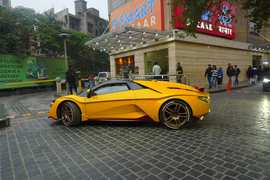
Pagani Utopia: The Zenith of Hypercar Engineering and Automotive Artistry
For over a quarter-century, Pagani Automobili has occupied a rarefied stratum in the automotive world, synonymous with peerless craftsmanship, breathtaking design, and an unwavering dedication to the art of the automobile. Now, in 2025, the latest chapter unfolds with the arrival of the Pagani Utopia, a successor to the legendary Huayra and the third distinct model line from Horacio Pagani’s visionary workshop. This is not merely a car; it’s a meticulously sculpted testament to mechanical perfection, a symphony of advanced composites, exotic alloys, and a potent V12 engine that redefines the very essence of the hypercar experience.
From its inception, the Pagani Utopia has been conceived as a harmonious fusion of art and engineering, a philosophy deeply rooted in the Renaissance ideals championed by Leonardo da Vinci, whom Horacio Pagani reveres. This ethos is palpable in every curve, every detail, and every precisely machined component. The Utopia embodies a bold departure from the ostentatious aerodynamic appendages that dominate much of the modern hypercar landscape. Instead, it embraces a purer, more organic aesthetic, celebrating form and function in equal measure, a sophisticated blend of performance prowess and timeless elegance.
The Heartbeat of the Utopia: A Bespoke V12 Symphony
At the core of the Pagani Utopia beats a colossal 6.0-liter, twin-turbocharged V12 engine, a marvel of engineering meticulously crafted by AMG in collaboration with Pagani. This powerplant is not just about raw numbers; it’s about the character it imbues into the driving experience. Producing a staggering 852 horsepower and an immense 811 lb-ft of torque, it delivers its prodigious output with a ferocity that is both exhilarating and, crucially, deeply engaging.
Experiencing the Utopia’s acceleration is unlike any other. Engage a lower gear, perhaps third or fourth, at a modest 30 mph, and then gently press the throttle. What follows is not the immediate, blunt-force trauma often associated with electric hypercars. Instead, there’s a tantalizing, brief pause, a gathering of breath before the twin-turbo V12 unleashes a tidal wave of longitudinal force. It’s a rapid, ever-intensifying squeeze that presses you back into the exquisitely crafted seat, a sensation that is both primal and utterly addictive. The initial moments can even trigger a visceral, almost childlike reflex, prompting a momentary release of the throttle, followed by a deep breath and an uncontrollable grin. This is the pure, unadulterated thrill of internal combustion at its zenith.
The auditory experience is equally captivating. The V12, while not a high-revving screamer with a stratospheric redline (peaking at 6,700 rpm), offers a rich, guttural bellow under acceleration. As boost pressure builds, a lion-like growl emanates from the depths of the 6-liter block, a sound that is both menacing and musical. When easing off the throttle, the exhaust system unleashes a barrage of pops, gurgles, and a deep, bass-heavy artillery fire, a visceral reminder of the immense power held in check. It’s a soundscape that perfectly complements the car’s potent performance.
A Manual Masterpiece: The Three-Pedal Revolution
In an era dominated by dual-clutch transmissions and electrification, the Pagani Utopia stands as a proud anachronism, offering a standard seven-speed manual gearbox. This is not a mere token gesture; it is a core tenet of the Utopia’s philosophy, a deliberate embrace of driver engagement and mechanical purity. This commitment is underscored by the fact that a remarkable 70% of Utopia customers opt for the manual transmission, a testament to its appeal among discerning enthusiasts.
Horacio Pagani and his team have invested an extraordinary amount of effort into perfecting this manual transmission. The clutch pedal, far from the weighty resistance of earlier manual supercars, is remarkably light and smooth. It offers just enough mechanical feel to be engaging, allowing for precise modulation and effortless engagement of the bite point for smooth, seamless departures. The gear shifter itself, a work of art machined from a solid billet of high-grade alloy, glides through its open gate with satisfying precision. While the shift action might be a fraction longer than some might expect, and lacks the distinct resistance of a gated Ferrari shifter, it is undeniably pleasing. The inclusion of a dog-leg first gear adds a touch of nostalgic charm, though the V12’s colossal torque makes pulling away in second gear entirely feasible. The spring bias guiding the lever towards the center line between shifts ensures that upshifts are slick and precise, adding to the overall tactile pleasure of gear changes.
Design Philosophy: Artistry Meets Aerodynamics
The Pagani Utopia’s exterior design is a masterclass in restraint and refinement. Eschewing the aggressive wings and gaping diffusers that have become commonplace in the hypercar segment, Pagani has opted for a more artistic and sculptural approach. The lines are fluid and organic, showcasing the natural beauty of advanced composite materials. Every piece of brightwork, from the smallest trim piece to the larger aerodynamic elements, is meticulously machined from billet aluminum, lending a jewelry-like quality to the car. This ensures that the entire vehicle feels as though it has been hewn from a single, solid block of material, an extraordinary feat of engineering and craftsmanship.
The Utopia’s silhouette is undeniably evocative of classic automotive design, yet it remains distinctly modern. The upswept dihedral doors, a signature Pagani feature, open to reveal a cockpit that is a dazzling exercise in controlled maximalism. Here, the fusion of art and science truly comes alive. The cabin is a riot of exquisite materials, intricate shapes, and opulent finishes. Familiar Pagani cues are present, from the periscope-like air vents and the floating crescent-shaped instrument binnacle to the flawless exposed carbon fiber structure. The clever use of glazing, extending into the roof panel, floods the interior with light, creating a sense of spaciousness and connection to the outside world.
The Analog Heartbeat in a Digital Age
Despite its advanced technological underpinnings, the Pagani Utopia proudly champions mechanical engagement. The analogue instruments are a particular highlight, featuring small portholes that reveal the intricate workings of the gauges, reminiscent of the intricate movements of a fine Swiss watch. This dedication to mechanical artistry extends to the steering wheel. Crafted with obsessive precision, it begins as a 43kg billet of high-grade alloy and undergoes 28 hours of five-axis machining to tolerances of just 0.5 microns. The final, hand-polished wheel weighs a mere 1.6kg, a testament to the meticulous attention to detail and the efficient recycling of the 41.3kg of material waste.
However, this analogue soul is seamlessly integrated with sophisticated, fully integrated electronics designed to enhance, rather than detract from, the driving experience. The Utopia offers a selection of dynamic driving modes: Comfort, Sport, Race, and Wet. These modes allow the driver to tailor the car’s demeanor, softening or sharpening its responses. A “Supersoft” mode provides an instant adjustment to the most compliant suspension setting, akin to Ferrari’s “bumpy road” button.
These electronic aids are expertly tuned. The semi-active TracTive dampers strike an impressive balance between bump absorption and body control, ensuring a remarkably composed ride even on imperfect surfaces. The Sport mode injects a dose of urgency into the Utopia’s character without rendering it overly nervous. Even when pushing hard, the Electronic Stability Control (ESC) provides a reassuring, yet subtle, layer of oversight, gently intervening when necessary to maintain composure.
Performance and Dynamics: A Sculpted Rocket
The Pagani Utopia’s performance is nothing short of sensational. The combination of its relatively light weight (1,280kg dry) and the immense power of its V12 engine creates a driving experience that feels incredibly energetic and alert. While outright power-to-weight ratios might be surpassed by some hybrid hypercars or electric supercars, the Utopia’s advantage lies in its agility and the sheer visceral connection it provides.
On the road, the Utopia is a revelation. Between corners, the car exhibits colossal potency, yet it also revels in braking zones and the turns themselves. The steering is light and precise, with quick reflexes but a calm demeanor that allows for uncanny accuracy in placing the car. Initially, one might desire a fraction more direct feedback, but with extended driving, the lack of distraction becomes apparent as a deliberate design choice, allowing the driver to focus on the nuances of the road and the car’s behavior.
In Race mode, the Utopia unleashes its full performance potential. The ESC allows for a delightful degree of controlled over-rotation at the rear wheels, offering an engaging, yet confidence-inspiring, experience. Corner exits are met with blistering acceleration, further enhanced by the Pirelli P Zero Corsa tires (265/35 R21 front and 325/30 R22 rear) that provide exceptional grip once warmed to the task.
The Brembo CCM-R brakes, featuring massive 410mm front and 390mm rear carbon-ceramic rotors clamped by six-piston front and four-piston rear calipers, provide immense stopping power. They are remarkably easy to modulate at low speeds and offer relentless, consistent bite at higher velocities, instilling unwavering confidence.
The Utopia Roadster: An Open-Air Symphony
Pagani has also introduced the Utopia Roadster, a convertible variant that maintains the coupe’s exceptional engineering and aesthetic integrity. Unlike previous Roadster models, the Utopia Roadster’s design was conducted concurrently with the coupe, resulting in even fewer compromises. The dry weight remains an identical 1,280kg, thanks to Pagani’s mastery of carbon fiber construction, which ensures exceptional tub rigidity without the need for additional reinforcement. Like its coupe sibling, the Utopia Roadster boasts worldwide homologation for safety and emissions.
While the engineering prowess remains undiluted, the Utopia Roadster commands a higher price tag, starting at £3.1 million, with production limited to 130 units. Production will proceed at a rate of approximately 50 to 60 cars per year, ensuring exclusivity.
A New Benchmark in Hypercar Excellence
The Pagani Utopia is more than just a successor to the Huayra; it is a bold statement about the future of the hypercar. It demonstrates that extreme performance can coexist with sublime refinement, that analogue driving pleasure can be enhanced by intelligent electronics, and that automotive design can transcend fleeting trends to achieve timeless artistry.
It is a car that doesn’t just chase numbers; it prioritizes harmony and driver engagement. The monumental biturbo V12, paired with the sweet-shifting manual gearbox, creates a transformative driving experience. The decision not to pursue astronomical horsepower figures or extreme rev limits has resulted in a powertrain that is both awe-inspiring and nuanced, delivering performance that is truly usable and enjoyable on the road at all speeds.
The Utopia embodies the best of Zonda-style purity and engagement, fused with the epic reach and modern refinements of the Huayra, all while carving its own distinct identity. Pagani has once again pushed the boundaries, delivering a contemporary masterpiece that adheres to its own timeless rules.
For those fortunate enough to experience the Pagani Utopia, it represents the pinnacle of automotive passion and engineering excellence. It’s an invitation to explore the limits of driving pleasure, to connect with a machine on a visceral level, and to witness firsthand the extraordinary artistry that defines the Pagani marque. Discovering the Pagani Utopia is not just about acquiring a car; it’s about becoming part of an exclusive narrative of automotive passion and unparalleled craftsmanship.