Unleashing the Roar: Production Cars Born from the Racetrack
For a decade now, my world has revolved around the pulsating heart of automotive innovation, particularly where the checkered flag meets the open road. I’ve witnessed firsthand how the relentless pursuit of speed and performance on the motorsport circuit doesn’t just influence design – it fundamentally shapes the very soul of production vehicles. We’re not talking about superficial styling cues or minor tuning; we’re discussing the visceral thrill of driving machines powered by engines conceived and refined in the crucible of professional racing. These powerhouses, forged in the intense heat of competition, deliver a high-revving, adrenaline-fueled experience that offers an undeniable connection to their racing brethren.
This exploration delves into ten production vehicles that masterfully blur the lines between the racetrack and the street. From the operatic wail of V12s to the brute force of turbocharged marvels, these ten automobiles provide a tangible taste of motorsport prowess for the everyday driver. But before we dive into these specific legends, let’s unpack why manufacturers invest so heavily in the demanding and costly arena of motorsports, and how those investments ultimately trickle down to the vehicles we can actually own and enjoy.
The Motorsport DNA Advantage: From Track to Tread
The symbiotic relationship between motorsports and road-going automobiles is as old as the automobile itself. Racing serves as the ultimate engineering proving ground, pushing the absolute limits of vehicle components and systems under extreme, unforgiving conditions where failure is not an option. The invaluable lessons learned and the innovative technologies pioneered on the track invariably find their way into the cars we drive daily. Whether it’s the subtle but significant advancements in aerodynamics, the development of lighter and stronger materials, or the trickle-down of sophisticated engine technologies, innovation born from racing directly contributes to the creation of superior road cars.
Consider, for instance, the widespread adoption of disc brakes and paddle shifters; both were revolutionary racing technologies before becoming commonplace features in production vehicles. Beyond engineering, motorsport success serves as a potent catalyst for a manufacturer’s brand image. When a company’s race cars consistently dominate on the circuit, the perception of their road cars is elevated, rendering them inherently more desirable to consumers. While most of us will never have the opportunity to pilot a Formula 1 car or a Le Mans prototype, we can still experience a direct connection to that high-octane world, particularly when a race-bred engine thrums beneath the hood of our personal vehicle.
The current resurgence of original equipment manufacturer (OEM) entries in various motorsport disciplines is a welcome development, potentially heralding one of the most significant periods of automotive advancement in decades. This strategic “win on Sunday, sell on Monday” approach isn’t just about marketing; it’s about demonstrating engineering excellence and fostering a culture of innovation that directly benefits the consumer.
Ten Legends Forged in the Fire of Competition
Let’s explore ten production vehicles that proudly wear their motorsport heritage on their sleeves, offering an unparalleled driving experience powered by track-derived engines.
Alfa Romeo Montreal
Engine: Tipo 33 Naturally Aspirated V8
Displacement: 2.6-liter
Horsepower: 200 hp
Torque: 173 lb-ft
The Alfa Romeo Montreal is a testament to the enduring appeal of a race-bred V8 in a road car. Its heart is a 2.6-liter V8 engine originally derived from Alfa Romeo’s legendary Tipo 33 sports prototype. This endurance racer competed in some of the most grueling events on the motorsport calendar, including the Targa Florio and the 24 Hours of Daytona. While carefully detuned for street legality and drivability, the engine in the Montreal retains a significant portion of its motorsport character. It happily revs to an impressive 7,000 RPM, delivering a spirited 200 horsepower. The intoxicating roar of its V8, combined with its striking, futuristic styling, cemented the Montreal’s status as one of the most captivating and arguably underrated cars to ever bear the Alfa Romeo badge. This classic V8 sports car offers a unique blend of Italian flair and racing pedigree.
BMW M1, M3 (E30), M5 (E28), M6 (E24)
Models: BMW M1, M5, M6; BMW M3
Engine: M88 Inline-Six; S14 Inline-Four
Displacement: 3.5-liter; 2.3-liter
Horsepower: 273 hp (M1); 282 hp (M5, M6); 197 hp
Torque: 251 lb-ft; 243 lb-ft
BMW’s M division is synonymous with motorsport excellence, and its iconic early models vividly demonstrate this. The legendary BMW M1, in particular, was powered by the formidable 3.5-liter inline-six M88 engine. This powerplant was directly born from the brand’s extensive racing programs, notably finding its application in the highly competitive BMW M1 ProCar series. The same potent engine later found its way into the acclaimed E24 M6 and E28 M5, delivering thrilling performance across BMW’s sportiest offerings. Furthermore, the four-cylinder S14 engine that powered the iconic E30 M3 was also deeply rooted in racing, drawing inspiration from the M88 and the turbocharged M12 Formula 1 engines. This engineering philosophy ensured that the E30 M3 shared vital components and engineering principles with the touring cars that dominated championships like the Deutsche Tourenwagen Masters (DTM). Owning these BMW M performance cars means owning a piece of racing history.
Chevrolet Camaro ZL1 (1969)
Engine: 427 Naturally Aspirated V8
Displacement: 7.0-liter
Horsepower: 430 hp
Torque: 450 lb-ft
The 1969 Chevrolet Camaro ZL1 is a muscle car legend with an engine originally conceived for the brutal world of Can-Am racing. This 427 cubic-inch (7.0-liter) V8 featured an all-aluminum construction, a significant engineering feat for its era, making it remarkably light for its immense displacement. While capable of producing a staggering 500 horsepower in its racing configuration, it was detuned to a still formidable 430 horsepower for its road-going application. The ZL1 package transformed the already potent Camaro into a street-legal drag strip monster, and its race-proven engine subsequently powered numerous competitors in the SCCA Trans-Am series. With only 69 examples ever produced, the 1969 Camaro ZL1 is an exceptionally rare and highly coveted collectible today, representing peak American muscle car engineering.
Ferrari Dino 206 GT
Engine: Dino Naturally Aspirated V6
Displacement: 2.0-liter
Horsepower: 180 hp
Torque: 138 lb-ft
The Ferrari Dino 206 GT, though often a subject of debate regarding its badge, houses a 2.0-liter V6 engine with undeniable motorsport lineage. This powerplant was originally developed for Ferrari’s Formula 2 racing efforts in the 1960s. Although modified for road use, the engine retained its high-revving nature, imbuing the Dino with a spirited racing character that made it an absolute joy to drive on winding roads. Producing 180 horsepower, it was more than sufficient for a car weighing just over 2,000 pounds. The Dino represented one of Ferrari’s initial forays into mid-engine V6 sports cars and, despite not bearing the iconic Prancing Horse emblem, it set a crucial precedent for future, more potent Ferrari models, showcasing the feasibility of smaller-displacement race-derived engines.
Ferrari F50
Engine: Tipo F130B Naturally Aspirated V12
Displacement: 4.7-liter
Horsepower: 513 hp
Torque: 347 lb-ft
To commemorate its 50th anniversary, Ferrari pushed the boundaries of what a production car engine could be with the F50, taking the concept of a track-derived powerplant to an entirely new level. Its 4.7-liter V12 engine was a direct descendant of the Tipo 641 Formula 1 car (later known as the F1-90) that legend Alain Prost piloted in 1990. This naturally aspirated masterpiece was engineered to rev to an astonishing 8,500 RPM, producing a searing 513 horsepower. It offered an unfiltered, raw experience that brought the visceral feeling of an F1 car directly to the road. With minimal modifications made solely to meet regulatory requirements, the F50 stood as the closest a street-legal Ferrari had ever come to replicating the Formula 1 experience. This supercar with F1 engine heritage remains a benchmark for performance and engineering purity.
Ford GT
Models: Ford GT (2005); Ford GT (2017)
Engine: Modular Supercharged V8; Twin-Turbo EcoBoost V6
Displacement: 5.4-liter; 3.5-liter
Horsepower: 550 hp; 647 hp
Torque: 500 lb-ft; 550 lb-ft
The Ford GT is a modern-day homage to one of the most legendary race cars in automotive history: the Le Mans-winning Ford GT40. The 2005 iteration featured a 5.4-liter supercharged V8 whose developmental roots were firmly planted in Ford’s endurance racing engine programs, bearing a strong relation to the powerplants used in Ford’s Daytona Prototype race cars. Similarly, the more contemporary 2017 Ford GT boasts motorsport-inspired performance, propelled by a twin-turbocharged 3.5-liter V6 derived from Ford’s highly successful EcoBoost program, which has seen extensive application in endurance racing. These Ford performance cars are a direct link to the brand’s celebrated racing legacy, particularly its triumphs at Le Mans.
Jaguar XJ220
Engine: XJR-11 Twin-Turbo V6
Displacement: 3.5-liter
Horsepower: 542 hp
Torque: 475 lb-ft
The Jaguar XJ220 stands as one of the most iconic vehicles from the esteemed British marque. Initially conceived with a V12 engine, the production model ultimately adopted a potent 3.5-liter twin-turbocharged V6 sourced directly from the Jaguar XJR-11 Group C race car. This competition-derived engine was instrumental in allowing the XJ220 to achieve a breathtaking top speed of 217 mph, earning it the title of the world’s fastest production car for a significant period. The XJ220’s motor was a prime example of cutting-edge track-proven technology successfully making its way into a road-legal supercar, solidifying its place as a true exotic car legend.
Plymouth Belvedere (1964)
Engine: 426 Naturally Aspirated Hemi V8
Displacement: 7.0-liter
Horsepower: 425 hp
Torque: 490 lb-ft
While the 1964 Plymouth Belvedere might not strike one as an obvious race car at first glance, its mechanical heart tells a different story. Under its hood resided the legendary 426 Hemi V8, an engine meticulously developed specifically for NASCAR competition. Known affectionately as the “Race Hemi,” this powerplant was an utterly dominant force on the racetrack and soon became available in Plymouth’s production vehicle lineup. The Belvedere equipped with this engine, delivering a robust 425 horsepower, rapidly established itself as one of the most powerful American muscle cars of the 1960s, a reputation that carried forward into the 1970s with the iconic Barracuda.
Porsche 918 Spyder
Engine: RS Spyder Naturally Aspirated V8 Hybrid
Displacement: 4.6-liter
Horsepower: 875 hp (combined)
Torque: 944 lb-ft (combined)
The Porsche 918 Spyder’s 4.6-liter V8 engine draws its DNA directly from the RS Spyder, a prototype race car that proved its mettle in the demanding LMP2 class at the 24 Hours of Le Mans. The 918 masterfully combined this race-bred V8 with advanced electric motors to achieve a truly staggering combined output of 887 horsepower. This hybrid powertrain enabled the 918 Spyder to achieve the iconic 0 to 60 mph sprint in a mere 2.2 seconds (as confirmed by independent testing), positioning it among the quickest production cars ever manufactured. While the electric motors contribute significantly to its blistering acceleration, it is the race-derived V8 that provides the car’s characteristic emotional resonance and exhilarating auditory experience. This hybrid supercar with racing pedigree showcases the future of performance.
Porsche Carrera GT
Engine: Porsche Naturally Aspirated V10
Displacement: 5.7-liter
Horsepower: 603 hp
Torque: 435 lb-ft
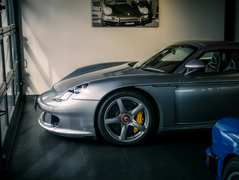
The Porsche Carrera GT is widely regarded as one of the greatest analog supercars ever constructed, and a significant portion of its legendary status is attributed to its captivating ten-cylinder engine. The 5.7-liter V10 was initially developed for Formula 1 during the V10 engine era. When that program didn’t materialize, the engine was shelved, only to be later repurposed for a Le Mans prototype car that never reached the track. Instead, Porsche ingeniously decided to install this race-honed engine into its flagship supercar. This allowed the Carrera GT to produce a formidable 612 horsepower and rev with exhilarating freedom all the way to 8,000 RPM. Coupled with its lightweight construction and inherent motorsport DNA, the Carrera GT remains a challenging yet incredibly rewarding driving machine, embodying the essence of a pure driving experience supercar.
These exceptional vehicles are more than just modes of transportation; they are rolling testaments to the power of motorsport to inspire and advance automotive engineering for the benefit of all enthusiasts. They offer a tangible connection to the thrill and prestige of racing, allowing drivers to experience a slice of automotive history and engineering prowess on public roads.
Are you ready to feel the pulse of motorsport in your daily drive? Explore our curated selection of performance vehicles or connect with our experts to find the perfect race-bred machine for your collection today.