
Unleashing Track Prowess: 10 Production Cars Born from the Racing World
For a decade now, I’ve been immersed in the automotive industry, witnessing firsthand the symbiotic relationship between cutting-edge racing technology and the cars that grace our public roads. It’s a fascinating dance, one where innovation born from the crucible of competition eventually finds its way into the vehicles we drive every day. This isn’t just about sporty aesthetics or minor performance enhancements; we’re talking about production vehicles that pack engines fundamentally designed for the rigors of motorsport. These powerhouses, honed in the intense heat of global racing circuits, deliver a visceral, high-revving, and utterly exhilarating performance that bridges the gap between the racetrack and the everyday commute.
In this exploration, we’ll delve into ten production vehicles that masterfully blur the lines between purebred race cars and road-legal machines. From the banshee wail of naturally aspirated V12s to the brute force of turbocharged titans, these machines offer a tangible connection to their racing brethren, allowing us to experience a sliver of motorsport glory from behind the wheel. But before we celebrate these incredible machines, let’s understand the profound reasons why automotive manufacturers invest vast resources into the demanding world of motorsport and how that strategic investment directly influences the caliber of vehicles available to the discerning driver.
The Enduring Symbiosis: Motorsport DNA in Road Cars
The intimate connection between motorsport and road-going automobiles is as old as the automobile itself. Racing serves as the ultimate proving ground, pushing the absolute boundaries of engineering. Cars and components are subjected to extreme conditions where even the slightest failure carries catastrophic consequences. The invaluable lessons learned, the innovations conceived, and the technologies perfected on the track invariably filter down to the cars we drive daily. Whether it’s the development of sophisticated aerodynamic profiles, the utilization of advanced lightweight materials, or the refinement of intricate engine technologies, the relentless pursuit of victory in racing directly fuels the evolution of superior road cars.
Consider, for instance, the widespread adoption of technologies like disc brakes and paddle shifters. These once-exclusive racing innovations are now standard features on countless production vehicles. Furthermore, motorsport success profoundly influences a manufacturer’s brand perception. When a company’s race cars dominate on the international stage, its road-going counterparts are naturally perceived as more desirable, more potent, and imbued with a winning spirit. While few of us will ever have the opportunity to pilot a Formula 1 machine or a Le Mans prototype, the presence of a race-bred engine purring beneath the hood of a production car offers a potent, exhilarating sensation of being part of that electrifying world. This phenomenon, often referred to as the “Win on Sunday, Sell on Monday” strategy, is experiencing a powerful resurgence, arguably representing one of the most beneficial developments for the automotive industry in decades. This renewed OEM commitment to motorsport is a crucial driver in bringing genuine track-inspired performance cars to a wider audience.
Ten Production Champions with Motorsport Hearts
Let’s celebrate ten remarkable production vehicles that embody the spirit of motorsport and bring its exhilarating performance directly to the public domain. These aren’t just aesthetically inspired; they are engineered with components and philosophies honed on the racetrack.
Alfa Romeo Montreal: A V8 Symphony from the Track
The Alfa Romeo Montreal is a testament to Italian passion and engineering prowess. Nestled beneath its striking lines lies a 2.6-liter V8 engine, a direct descendant of Alfa Romeo’s legendary Tipo 33 sports prototype. This endurance racer competed in prestigious events like the Targa Florio and the grueling 24 Hours of Daytona. While meticulously detuned to meet road-legal standards, the Montreal’s V8 engine retains a significant portion of its motorsport character. It readily spins to an impressive 7,000 RPM, delivering a healthy 200 horsepower. The commanding roar of its V8, coupled with its distinctive, sharp styling, cemented the Montreal’s status as one of the most captivating and often underestimated vehicles ever to wear the Alfa Romeo badge. The enduring appeal of V8-powered sports cars is undeniable, and the Montreal exemplifies this.
BMW M1, M3 (E30), M5 (E28), M6 (E24): The M Division’s Racing Roots
BMW’s M division is synonymous with high-performance vehicles, and their racing pedigree is indelibly etched into their most iconic models. The BMW M1, a mid-engined marvel, was propelled by the formidable 3.5-liter inline-six M88 engine. This powerplant was directly derived from the brand’s highly successful racing programs, notably the single-make BMW M1 ProCar series. The very same engine later found its way into the legendary E24 M6 and the E28 M5, imbuing them with exceptional performance. Meanwhile, the four-cylinder S14 engine powering the E30 M3 shared its fundamental architecture with the M88 and the turbocharged M12 Formula 1 engines. This engineering lineage clearly demonstrates BMW’s dedication to transferring racing technology, drawing inspiration from their dominant touring car campaigns and sharing critical components and engineering principles with the DTM racing machines that conquered their era. These performance BMW models represent a pinnacle of road-going race car technology.
Chevrolet Camaro ZL1 (1969): A Can-Am Beast Unleashed
The 1969 Chevrolet Camaro ZL1 was a true anomaly, a production car engineered with an engine conceived for the brutal world of Can-Am racing. Its heart was a monumental 427 cubic-inch (7.0-liter) V8, an all-aluminum powerhouse designed for maximum performance and minimal weight. In its full racing trim, this engine was reputed to produce a staggering 500 horsepower, though it was conservatively rated at 430 horsepower for its road-going iteration. The ZL1 package transformed the Camaro into a street-legal drag strip dominator, and its formidable engine continued to see service in various race cars competing in the SCCA Trans-Am series. With a production run of only 69 units, the Camaro ZL1 remains an exceptionally rare and highly coveted collector’s item today, a true embodiment of American muscle cars with racing pedigree.
Ferrari Dino 206 GT: A Taste of Formula 2 Excellence
The Ferrari Dino 206 GT, though often a point of discussion regarding its badge, holds a significant place in Ferrari’s history and its connection to motorsport. It featured a nimble 2.0-liter V6 engine, originally developed for Ferrari’s Formula 2 racing aspirations in the 1960s. While detuned for public roads, this engine maintained its thrilling high-revving character, imbuing the Dino with an undeniable racing spirit that made it an absolute joy to pilot on winding country lanes. Producing 180 horsepower, this powerplant was more than adequate for a car weighing just over 2,000 pounds. The Dino represented a pivotal moment for the Italian marque, marking their initial foray into mid-engined V6 sports cars and setting a precedent for future models, demonstrating Ferrari’s early exploration into compact V6 sports cars with racing DNA.
Ferrari F50: Formula 1 for the Road
The Ferrari F50, conceived to commemorate the iconic Italian marque’s 50th anniversary, represents an almost unparalleled elevation of the track-derived engine concept. Its heart is a potent 4.7-liter naturally aspirated V12, directly borrowed from Ferrari’s 1990 Formula 1 challenger, the Tipo 641 (later known as the F1-90), famously driven by Alain Prost. This naturally aspirated masterpiece screams to an incredible 8,500 RPM, unleashing 513 horsepower and delivering the raw, unfiltered sensation of driving an F1 car on public roads. With minimal modifications necessary to comply with street regulations, the F50 was, at the time, as close as one could get to experiencing Formula 1 in a road-legal Ferrari. The F50 stands as a prime example of supercar engineering directly from Formula 1.
Ford GT: A Modern Homage to Le Mans Legends
The Ford GT is a purposeful and highly successful homage to one of the most legendary race cars in history: the Le Mans-winning Ford GT40. The first generation GT, produced from 2005, was equipped with a 5.4-liter supercharged V8 engine. Its development was deeply intertwined with Ford’s endurance racing engine programs, sharing engineering lineage with the powerplants used in Ford’s Daytona Prototype race cars. The more contemporary 2017 Ford GT continues this proud tradition, boasting race-inspired performance from its twin-turbocharged 3.5-liter V6. This EcoBoost engine is a direct product of Ford’s extensive experience in endurance racing, underscoring the brand’s enduring commitment to pushing the boundaries of performance vehicle development through motorsport.
Jaguar XJ220: The Twin-Turbocharged Speed Demon
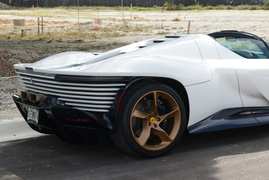
The Jaguar XJ220 remains one of the most iconic and audacious vehicles to emerge from the esteemed British marque. While initially conceived with a V12 engine, its final production form featured a formidable 3.5-liter twin-turbocharged V6 engine sourced directly from the Jaguar XJR-11 Group C race car. This competition-honed powerplant was instrumental in propelling the XJ220 to a blistering top speed of 217 mph, briefly crowning it the fastest production car in the world. The XJ220’s engine represented a pinnacle of track-proven technology successfully integrated into a road-legal automobile, showcasing the extraordinary capabilities of high-performance V6 engines in the supercar realm.
Plymouth Belvedere (1964): The Hemi’s NASCAR Heart
At first glance, the 1964 Plymouth Belvedere might not immediately scream “race car.” However, beneath its unassuming exterior beat the legendary 426 Hemi V8 engine, an powerplant developed with NASCAR dominance firmly in mind. Known affectionately as the “Race Hemi,” this engine was a titan on the racetrack and soon found its way into Plymouth’s production lineup. The road-going Belvedere, boasting a formidable 425 horsepower, quickly established itself as one of the most potent muscle cars of the 1960s – a reputation that carried through to the ’70s with the iconic ‘Cuda. This exemplifies how NASCAR-inspired engines can define an era of performance cars.
Porsche 918 Spyder: Hybrid Hypercar with a Racing Soul
The Porsche 918 Spyder is a hypercar that masterfully blends cutting-edge hybrid technology with purebred motorsport DNA. Its 4.6-liter naturally aspirated V8 engine is based on the RS Spyder, a prototype race car that competed in the demanding LMP2 class at the 24 Hours of Le Mans. In the 918 Spyder, this race-derived engine is synergistically paired with electric motors, resulting in a combined output of a staggering 887 horsepower. This allows the hypercar to achieve a breathtaking 0 to 60 mph sprint in a mere 2.2 seconds, placing it among the quickest production vehicles ever conceived. While the electric motors contribute significantly to its astonishing acceleration, it is the race-derived V8 that delivers the car’s soul-stirring emotional and auditory experience, showcasing the future of hybrid hypercars with racing heritage.
Porsche Carrera GT: The Ultimate Analog Supercar
The Porsche Carrera GT is widely revered as one of the greatest analog supercars ever constructed, and much of its legendary status is attributed to its extraordinary ten-cylinder engine. The 5.7-liter V10 powerplant was initially developed for Formula 1 during the V10 era. When that project didn’t materialize, the engine was shelved, only to be resurrected for a Le Mans prototype car that ultimately never raced. Instead, Porsche made the inspired decision to integrate this race-honed engine into its flagship supercar. This decision empowered the Carrera GT to produce 612 horsepower and achieve an exhilarating 8,000 RPM redline. With its featherlight construction and undeniable motorsport DNA, the Carrera GT remains a challenging and profoundly rewarding driving experience, a true testament to the enduring allure of naturally aspirated V10 engines in modern supercars.
The Enduring Legacy of Motorsport in Automotive Innovation
The automotive landscape is continually shaped by the relentless pursuit of speed and performance on the racetrack. The technological advancements, engineering refinements, and sheer passion that fuel motorsport translate directly into the vehicles we can experience and enjoy on public roads. These ten production cars, each with a lineage steeped in racing heritage, offer a tangible connection to that world. They demonstrate that the thrill of competition isn’t confined to the circuits; it can be a visceral part of your daily drive.
Whether you are a seasoned automotive enthusiast or simply appreciate finely engineered machines, exploring vehicles with genuine motorsport DNA offers a unique and exhilarating perspective on automotive achievement. The innovation, the dedication, and the sheer performance on display are undeniable.

Ready to experience the thrill of track-bred performance for yourself? Explore our curated selection of vehicles that embody the spirit of motorsport, or contact our expert team to discuss finding the perfect performance car that speaks to your passion for speed and engineering excellence.