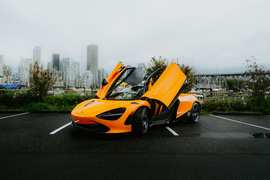
Pagani Utopia: A Masterpiece of Mechanical Artistry and Uncompromising Performance
For over a decade, the automotive landscape has been dominated by a singular narrative: electrification. We’ve witnessed the rise of silent, instant torque machines, pushing the boundaries of acceleration with a clinical, almost detached efficiency. Yet, amidst this electric revolution, a different kind of automotive fervor has been quietly brewing, championed by a select few who believe that the soul of a hypercar lies not just in raw numbers, but in the visceral, tactile connection between man and machine. It is within this rarefied atmosphere that the Pagani Utopia emerges, not as a successor, but as a bold declaration of principles, a testament to the enduring allure of internal combustion, and a £2.2 million masterpiece that redefines the very essence of the hypercar formula.
Having spent ten years immersed in the world of high-performance vehicles, from track-day machines to bespoke ultra-luxury grand tourers, I can attest to the evolution of what defines a hypercar. It’s no longer just about staggering horsepower or mind-bending lap times, though the Utopia possesses these in abundance. It’s about the symphony of mechanical components, the exquisite craftsmanship that transforms metal and carbon fiber into art, and the profound sense of occasion that each drive delivers. The Pagani Utopia, as the third distinct model line from Horacio Pagani’s eponymous marque in over a quarter-century, embodies this philosophy with an unyielding commitment that is both breathtaking and profoundly moving. It’s a car that doesn’t just demand your attention; it commands your reverence.
The Heartbeat of a Legend: The AMG-Built V12
At the core of the Utopia beats a heart forged in the hallowed halls of AMG: a 6.0-liter, twin-turbocharged V12 engine. This isn’t just an engine; it’s a technological marvel, meticulously hand-built and tuned to produce a staggering 852 horsepower and a colossal 811 lb-ft of torque. This powerplant is the lifeblood of the Utopia, delivering its prodigious output not with the blunt force of an electric motor, but with a nuanced, escalating wave of acceleration that is as intoxicating as it is utterly relentless.
Experiencing this V12 for the first time is an event. Imagine yourself cruising at a modest 30 mph, nestled within one of the lower gears. As you gently press the accelerator, there’s a brief, almost anticipatory pause – a moment of mechanical contemplation. Then, the V12 awakens. It inhales deeply, its twin turbos spooling with a rising intensity, transforming the air into pure, unadulterated kinetic energy. The sensation is not an abrupt jolt, but a powerful, ever-intensifying longitudinal force that presses you back into your seat. It’s a primal sensation, a raw dialogue between driver and machine that evokes the visceral thrill of a perfectly executed slingshot. The initial surge might even elicit a primal reaction, a momentary disorientation as your body adjusts to the sheer magnitude of acceleration. But once you regain your composure, what follows is an unadulterated rush of adrenaline, a sense of pure, unbridled joy that compels you to repeat the experience, again and again.
This raw, explosive power is a deliberate choice, a cornerstone of the Utopia’s appeal. Unlike the immediate, albeit often sterile, torque delivery of electric hypercars, the Pagani V12 offers a journey. It’s a masterclass in how to build excitement, how to engage the driver’s senses, and how to create a truly unforgettable performance experience. The engine’s character is richer, more outgoing, and possesses a sharper, steelier edge than its predecessor, the Huayra. It’s an engine that sings a song of power and precision, a mechanical aria that resonates deep within the soul.
A Symphony of Design: Artistry Meets Engineering
Horacio Pagani’s design ethos has always been deeply rooted in the principles of art and science, inspired by the Renaissance polymath Leonardo da Vinci. The Utopia is the ultimate manifestation of this philosophy. It is a car that transcends mere automotive design; it is a sculpture on wheels, a harmonious fusion of form and function.
At first glance, the Utopia eschews the overt aerodynamic appendages that have become commonplace on modern hypercars. There are no colossal wings or gaping venturi tunnels dominating the silhouette. Instead, Pagani has pursued a path of artistic endeavor, celebrating purity of form while indulging in lavish embellishment and eye-catching flourishes. The result is a design that is both timeless and utterly contemporary, a testament to the enduring power of elegant proportions and meticulous detailing.
Every single piece of exterior and interior brightwork is machined from solid billet. This obsessive attention to detail lends the Utopia a jewelry-like quality, creating the illusion that the entire car has been hewn from a single, monolithic piece of metal. This commitment to craftsmanship is evident in every curve, every line, and every surface. The compound curves of the bodywork are mesmerizing, drawing the eye and inviting exploration. The upswept dihedral doors, a signature of modern supercars, open to reveal a cockpit that is nothing short of extraordinary.
Stepping inside the Utopia is like entering a meticulously curated museum of automotive art. The cabin is a dazzling exercise in maximalism, brimming with exquisite materials and a riot of shapes and finishes. Familiar Pagani cues are present, such as the periscope-shaped air vents and the floating crescent-shaped instrument binnacle. The exposed carbon fiber structure is not hidden but celebrated, a testament to the car’s lightweight construction. Glazing extends into the roof panel, bathing the interior in light and creating a sense of spaciousness.
The emphasis on mechanical artistry is profound. The analogue instruments feature small portholes, offering a glimpse into their intricate inner workings, reminiscent of the finest Swiss timepieces. And then there is the gear shifter. Rising from the transmission tunnel like a piece of abstract sculpture, this machined-from-solid lever for the optional seven-speed manual gearbox proudly displays its complex linkage, a visible celebration of its mechanical soul.
The steering wheel itself is a prime example of Pagani’s dedication to precision engineering. Starting life as a 43kg billet of high-grade alloy, it undergoes 28 hours of five-axis machining to tolerances of just 0.5 microns, followed by a meticulous hand-polishing process. The finished wheel weighs a mere 1.6kg, a remarkable feat of material reduction, with the 41.3kg of leftover swarf being meticulously recycled – a nod to sustainability in the pursuit of perfection. This commitment to engineering excellence is what sets Pagani apart, transforming mere components into works of functional art.
The Tactile Thrill: The Three-Pedal Dance
In an era where manual transmissions are becoming increasingly rare, especially in the hypercar segment, the Pagani Utopia makes a bold statement by offering an optional seven-speed manual gearbox. This is not a concession; it’s a deliberate embrace of tradition, a commitment to the purest form of driving engagement.
The clutch pedal, often a point of contention in high-performance manuals, is surprisingly light and smooth. It offers just enough resistance to feel mechanical, allowing for a precise and intuitive engagement of the clutch bite point, making pulling away a delight rather than a challenge. The shift action is clean and precise, perhaps a fraction longer than some might expect, but undeniably pleasing. The inclusion of a dog-leg first gear adds a nostalgic touch, but the sheer abundance of torque from the V12 means that pulling away in second gear is entirely feasible. The positive spring bias on the lever ensures slick and precise upshifts into all subsequent gears. It’s no surprise that a remarkable 70 percent of Utopia customers opt for the manual transmission, a testament to the enduring appeal of this purist’s choice.
For those seeking the ultimate tactile experience, the Utopia delivers in spades. The ability to precisely manage gear selection, to feel the mechanical connection through the gear lever, and to orchestrate the V12’s symphony with your own inputs elevates the driving experience to an art form. It transforms a simple drive into a performance, a dance between driver, machine, and the open road.
Navigating the Digital Realm: Intelligent Electronics
While the Utopia proudly wears its analogue heart on its sleeve, it is by no means devoid of modern technological sophistication. Pagani has seamlessly integrated advanced electronics to enhance the driving experience without compromising its inherent character.
A selection of dynamic modes – Comfort, Sport, Race, and Wet – allows drivers to tailor the Utopia’s demeanor to suit their mood and the prevailing conditions. These modes judiciously adjust throttle response, suspension settings, and electronic stability control (ESC) interventions. A ‘Supersoft’ mode offers an immediate softening of the suspension, akin to Ferrari’s ‘bumpy road’ button, providing an extra layer of compliance when needed.
However, the genius lies in the execution. The semi-active TracTive dampers are exceptionally well-judged, achieving an impressive balance between bump absorption and body control. In my experience, ‘Sport’ mode offers the ideal blend of responsiveness and composure, injecting a shot of exhilaration without making the car feel overly nervous. The ESC system provides reassuring oversight, gently intervening to manage wheelspin on corner exits without overtly intruding on the driving pleasure.
Even when venturing into ‘Race’ mode, which unlocks the full potential of the V12, the ESC allows for a degree of controlled over-rotation at the rear wheels, fostering a more engaging and exhilarating driving experience, while still retaining a dependable safety net. This intelligent application of electronics allows the driver to explore the Utopia’s limits with confidence, fostering a sense of connection and control that is paramount in a car of this caliber.
The Art of Dynamics: Poise and Precision
The Utopia’s chassis is a marvel of modern engineering, utilizing a lightweight carbon-titanium monocoque that provides exceptional rigidity and a sensational power-to-weight ratio. At 1280kg dry (1340kg wet) and boasting 852bhp, it offers a performance envelope that can rival even the most potent hybrid hypercars. However, the Utopia’s advantage lies in its inherent agility and responsiveness, a direct result of its lower mass.
On the road, this translates into a car that feels incredibly alive. Between corners, the colossal potency of the V12 is always on hand, but it’s in the braking zones and through the turns that the Utopia truly shines. It feels natural, predictable, and remarkably exploitable. The steering is light and precise, offering quick responses without sacrificing composure. It allows for uncanny accuracy in placing the car, with the inside front wheel seemingly guided to the apex with unerring precision.
While initially one might crave a fraction more tactile feedback, the subtle lack of distraction is, in fact, part of the Utopia’s playbook. It allows the driver to focus on the flow of the drive, to immerse themselves in the experience without being overwhelmed by extraneous sensations. Coupled with the light clutch, the slick gearbox, and the titanic powerplant, the result is a car that you don’t fight; you harmonize with.
The braking system is equally impressive. Massive 410mm front and 390mm rear Brembo CCM-R discs, gripped by formidable six-piston front and four-piston rear calipers, deliver immense stopping power. The pedal feel is consistently firm and progressive, providing confidence-inspiring modulation at low speeds and immense bite at higher velocities.
A Utopia of Performance: The Roadster Variant
Pagani has continued its tradition of offering open-top variants, with the Utopia Roadster mirroring the coupe’s groundbreaking design process, conceived concurrently rather than as an afterthought. This simultaneous development has resulted in a car with even fewer compromises. The dry weight remains an identical 1280kg, a testament to Pagani’s unparalleled mastery of carbon fiber, which allows the bespoke tub to retain exceptional rigidity without the need for excessive reinforcement. Like its coupe counterpart, the Utopia Roadster benefits from worldwide homologation for both safety and emissions.
However, the pursuit of open-air exhilaration comes at a premium. The Utopia Roadster commands a price of £3.1 million, with production capped at 130 units. Production is expected to be between 50 and 60 cars per year, ensuring its exclusivity remains paramount.
The Pagani Utopia: A Timeless Vision
The Pagani Utopia is more than just a hypercar; it’s a philosophical statement. It’s a rejection of the homogenizing trends that often define the modern automotive landscape. Yes, it is blisteringly fast and immensely powerful, but its true genius lies in its pursuit of perfect harmony. It prioritizes balance and driver engagement over outright extremes, understanding that true automotive nirvana is found in the seamless integration of all its elements.
The marriage of the monumental biturbo V12 to a sweet-shifting manual gearbox is transformative. The decision to forgo stratospheric horsepower figures in favor of nuanced, road-focused performance makes the Utopia a joy to drive at all speeds. Its ability to meet global emissions and homologation standards is a testament to Pagani’s meticulous engineering and the invaluable partnership with AMG as its engine supplier.
Sophisticated electronics, often seen as anathema to the analog driving experience, are here employed with exquisite finesse. Adaptive damping, ESC, and the electronic differential work in concert to enhance the feel and dynamism that discerning drivers crave, taming the Utopia when necessary but always serving to amplify the joy of the drive.
The result is a car that is savagely quick and sublimely sorted. It captures the raw purity and engagement of the Zonda, melds it with the epic reach and modern refinement of the Huayra, and imbues it with its own authentic character and distinct capabilities. The Pagani Utopia moves the game forward, but it does so on its own terms, adhering to its own timeless rules. It is contemporary where it counts and timeless where it truly matters. Pagani has, once again, achieved automotive perfection.
For those who appreciate the pinnacle of automotive artistry and uncompromising driving dynamics, the Pagani Utopia represents an unparalleled opportunity to own a piece of automotive history. To explore the bespoke customization options or to inquire about securing your place within the Pagani family, we invite you to connect with an authorized Pagani representative today and begin crafting your own personal Utopia.