Full Video : H2611013 DRUNK PARENTS STUMBLE OUT OF BAR TO FIND COPS! Reckless Couple Shocked Seeing Officers Holding Baby! 🍺👶 #cops #police #bodycam #viral
Pagani Utopia 2025: Hypercar Excellence Redefined
The Pagani Utopia, the brand’s third model in over a quarter-century, builds upon the celebrated legacies of the Zonda and Huayra, introducing its distinctive character and an exhilarating 852bhp twin-turbo V12 engine.
EVO RATING
RRP: From £2,200,000
Highlights: Uncompromising performance, exquisite detailing, manual transmission option.
Considerations: Limited availability.
The sheer force of the Utopia’s torque is an immediate and profound sensation. At moderate speeds in lower gears, the 6-litre, AMG-developed twin-turbo V12 delivers an explosive surge of power, transforming the driving experience into a visceral encounter with longitudinal G-forces. This is not the abrupt impact of electric powertrains, but a potent, intensifying pressure that elicits an immediate, almost involuntary, physical response, followed by a rush of adrenaline and undeniable exhilaration. The novelty of such immediate acceleration never fades, demonstrating the elemental appeal of this extraordinary machine.
Drawing inspiration from Sir Thomas More’s concept of an ideal society, Horacio Pagani’s Utopia presents a tangible reality: a £2,200,000, 1280kg hypercar capable of 217mph, powered by an 852bhp twin-turbo V12, and meticulously crafted from advanced composites and exotic alloys. While More’s vision remained theoretical, Pagani’s is attainable for the exclusive 99 customers who have secured a coupe build slot, with Roadster variants also anticipated. For automotive journalists, experiencing the Utopia is a privilege, a fleeting opportunity to immerse oneself in the rarefied atmosphere of ultra-high-net-worth automotive passion.
New Pagani models are infrequent, a testament to their meticulous development. The Utopia, the third new model line from Pagani’s San Cesario sul Panaro facility in 26 years, has been a highly anticipated arrival.
Significant evolution has occurred at Pagani since its inception. The company’s current headquarters, the ‘Atelier,’ opened in 2017, now houses production, alongside specialized departments for restoration, personalization, and bespoke projects. The original Art & Science Research Centre, once the company’s sole base, now serves as a modest workshop for prototype development.
The Utopia experience commences from the passenger seat, alongside Pagani’s R&D test driver, Alberto Scilla. This initial phase provides invaluable insight into the vehicle’s behavior and performance dynamics, a process built on trust and mutual respect.
The Futa Pass, a revered route near Pagani’s HQ and a segment of the historic Mille Miglia, offers the ideal setting to appreciate the Utopia’s capabilities discreetly. Accompanied by the camera car, Scilla and the author navigate the Autostrada A1, an early indication of the Utopia’s remarkable composure and the sheer delight of its initial presence.
Even from the passenger seat, the Utopia delivers a captivating experience. Its ride is surprisingly supple, and while the V12 remains a constant presence, it is never overwhelming at lower speeds. The engine’s power is evident, yet refined, showcasing a blend of everyday usability and breathtaking performance that Pagani has consistently championed.
Significant effort has been dedicated to refining the manual transmission, focusing on both shift quality and clutch feel. Managing the immense torque of 811lb ft presents a considerable challenge, yet the Utopia’s manual gearbox achieves a level of delicacy that truly celebrates traditional stick-shift engagement, as demonstrated by Scilla’s precise gear changes.
Cruising on the Autostrada, the Utopia effortlessly cuts through traffic, commanding a presence that parts the way ahead, reminiscent of the iconic Group B rallying era. Occasional, spirited throttle applications unleash the V12’s magnificent roar, a sound richer and more characterful than the Huayra’s, yet with a sharper, more potent edge. The engine is, without question, a masterpiece.
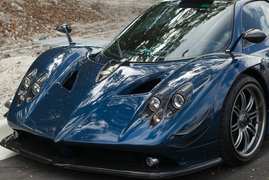
A brief stop for refueling draws an immediate crowd, a testament to the Utopia’s captivating design. Despite its familiarity, the car’s alluring form continues to mesmerize, even after an extended period within its embrace. The design deliberately eschews overt aerodynamic appendages, prioritizing a purer, more artistic form that is both elegantly embellished and visually striking – the quintessence of Pagani’s distinctive aesthetic.
The weight of the key, a finely machined Utopia-shaped puck, only enhances the anticipation. The exterior and interior brightwork, meticulously machined from billet, contribute to a jewel-like quality, giving the impression that the entire vehicle has been sculpted from a single block of material.
The signature upswept dihedral doors, a departure from the Huayra’s gullwings and the Zonda’s conventional hinges, reveal an extraordinary cockpit. A symphony of exquisite materials and dynamic forms defines this maximalist interior. Familiar Pagani design cues, such as the periscope air vents and crescent-shaped instrument binnacle, are present, complemented by exposed carbonfibre structures and expansive glazing that extends into the roof, enhancing light and perceived space.
True to its philosophy, the Utopia celebrates mechanical artistry. Analogue instruments, featuring small portholes revealing their inner workings, evoke the craftsmanship of high-end Swiss watches. The machined-from-solid gear shifter, an optional seven-speed manual, stands as a sculptural element on the transmission tunnel, its complex linkage proudly displayed.
Pagani’s passion for engineering excellence, deeply influenced by Leonardo da Vinci’s fusion of art and science, is evident throughout the Utopia. The steering wheel, a prime example, undergoes a complex manufacturing process involving over 750 individual components, starting as a 43kg alloy billet and being meticulously machined to micron tolerances over 28 hours, before a hand-polishing stage reduces its weight to a mere 1.6kg. The 41.3kg of recycled swarf underscores the efficiency of this process.
Unlike earlier manual supercars, the Utopia’s clutch pedal offers a light and precise feel. The engagement point is easily discernible, allowing for smooth departures. The gear shifts are clean and effortless, characterized by a pleasing, albeit slightly longer, throw than some competitors, but offering a distinct sense of mechanical satisfaction.
The dog-leg first gear adds a nostalgic touch. The V12’s abundant torque at low RPMs permits effortless acceleration in second gear, while the positive spring bias ensures slick and precise upshifts. This has contributed to 70% of Utopia customers opting for the manual transmission.
Despite its analogue aesthetic, the Utopia incorporates advanced, integrated electronics. Dynamic modes – Comfort, Sport, Race, and Wet – offer adjustable responsiveness, while a Supersoft mode provides immediate access to the most pliant suspension setting.
The semi-active TracTive dampers offer an impressive balance of bump absorption and body control, minimizing the need for frequent mode changes. Sport mode provides an optimal blend of responsiveness without compromising composure. The ESC offers subtle intervention, ensuring composed progress, particularly when paired with the Pirelli P Zero Corsas.
Engaging Race mode requires careful consideration, balancing performance potential with the responsibility of preserving a vehicle of such significant value. However, the compromise of selecting Race while retaining ESC intervention proves to be the most judicious approach. Race mode unleashes the Utopia’s full performance envelope, while the relaxed ESC allows for controlled rear-wheel rotation, balanced by dependable intervention when necessary.
The progression through the gears in the Utopia is akin to being launched by a rocket. The AMG-built V12, though not a high-revving unit (redlining at 6700rpm), delivers a potent and deeply satisfying experience in each gear. Third and fourth gears become the primary conduits for exhilarating acceleration, with occasional excursions into fifth and brief downshifts to second. In Race mode, the V12’s exhaust note intensifies, a guttural symphony punctuated by induction and turbocharger sounds, and a deep, artillery-like rumble on deceleration.
This raw, explosive power contrasts with the Utopia’s elegant design and refined character. However, its precision, poise, and perceived compactness are entirely contemporary. The driving dynamics of large supercars have been redefined by newer models, and the Utopia, with its titanium-infused carbonfibre construction and mechanical purity, benefits from a genetic advantage. Despite its timeless objectives, it has seamlessly adapted to modern automotive advancements.
Power-to-weight ratios, while informative, do not fully capture the driving experience. The Utopia, weighing 1280kg dry (1340kg wet) and producing 852bhp and 811lb ft, may be outperformed numerically by some EV hypercars. However, its lighter mass renders it more agile and responsive at all times.
On optimal road sections, this translates to immense potency between corners, exceptional braking performance, and a sublime experience through turns. The Utopia feels natural, predictable, and exploitable, encouraging drivers to delve into its substantial performance reserves. The steering is light and precise, offering swift responses while maintaining the calmness required for accurate apex targeting. The ability to meticulously place the inside front wheel is remarkable. Initial requests for increased steering connection are soon understood as part of the Utopia’s deliberate design for reduced distraction. Combined with the light clutch, smooth gearbox, and potent powerplant, the driving experience is one of effortless harmony.
The Utopia’s massive 410mm front and 390mm rear Brembo CCM-R brakes, equipped with six-piston front and four-piston rear calipers, deliver progressive and formidable stopping power. They are easily modulated at low speeds and provide immense, confidence-inspiring bite at higher velocities, with a consistently firm pedal feel.
The magic of the Pagani Utopia lies in its transcendence of conventional hypercar paradigms. While undeniably powerful and exceptionally fast, its core philosophy, as its name suggests, emphasizes perfect harmony over extreme performance at the expense of overall balance. The marriage of the monumental biturbo V12 with a finely tuned manual gearbox is transformative. Furthermore, eschewing the pursuit of four-digit horsepower figures or excessively high redlines results in a powertrain that delivers exhilarating yet nuanced performance, perfectly suited for road use at all speeds. Its adherence to global emissions and homologation standards underscores Pagani’s meticulous approach and the value of its partnership with AMG.
Sophisticated electronics, often seen as antithetical to organic, analogue driving experiences, are masterfully integrated. Adaptive damping, ESC, and e-diff collectively enhance the Utopia’s dynamic feel and responsiveness, providing refinement and control when needed.
The result is a car that is both savagely quick and sublimely composed. It merges the purity and engagement of the Zonda with the epic reach and modern refinements of the Huayra, all while imbuing its own authentic character and distinct capabilities. The Utopia advances the hypercar benchmark while adhering to its own distinctive principles, blending contemporary relevance with timeless appeal. Pagani has once again delivered an automotive masterpiece.
Driving the Pagani Utopia Roadster
Unlike its predecessors, the Utopia Roadster was conceived concurrently with the coupe, resulting in a vehicle with minimal compromises. Its dry weight remains an identical 1280kg, with Pagani’s expertise in carbonfibre ensuring exceptional tub rigidity without the need for additional structural reinforcement. The Utopia Roadster, like the coupe, meets global safety and emissions standards.
Production numbers and pricing are higher for the Roadster, with each of the 130 units priced at £3.1 million. Annual production is projected to be between 50 and 60 vehicles.