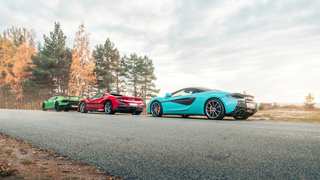
The inherent thrill of driving a vehicle with motorsport DNA is profound. This distinction transcends mere race-inspired aesthetics or performance enhancements; it refers to vehicles equipped with powertrains originally engineered for track competition. Such engines, honed through rigorous racing environments, deliver exhilarating, high-revving performance on public roads, forging a direct connection to their racing counterparts.
This compilation explores ten production vehicles that skillfully bridge the gap between motorsport and road legality. From the resonant roar of V12s to the formidable power of turbocharged engines, these vehicles offer a tangible experience of race car dynamics for everyday drivers. However, before delving into these specific models, it is pertinent to examine the rationale behind manufacturers’ significant investment in motorsport and its consequential impact on the vehicles available to the general public.
Motorsport DNA Integrated into Road-Going Vehicles
The symbiosis between motorsport and automotive development is long-standing. Racing serves as an extreme proving ground for engineering, subjecting vehicles and components to intense conditions where failure is not an option. The advancements and lessons learned on the track invariably filter down to the production vehicles we use daily. Whether through sophisticated aerodynamics, the application of lightweight materials, or the trickle-down of engine technology, innovations born from racing directly contribute to the evolution of superior road cars.
Historically, technologies such as disc brakes and paddle shifters originated in racing before becoming standard features in production vehicles. Furthermore, motorsport success significantly enhances a manufacturer’s brand image. A dominant performance on the track translates into a perception of enhanced desirability for a company’s road cars. While direct ownership of a Formula 1 car or a Le Mans prototype remains exclusive, the experience of motorsport participation can be approximated, particularly when a race-bred engine powers a production vehicle.
Featured Vehicles with Motorsport Provenance:
Alfa Romeo Montreal
Engine: Tipo 33 Naturally Aspirated V8
Displacement: 2.6-liter
Horsepower: 200 hp
Torque: 173 lb-ft
The Alfa Romeo Montreal features a 2.6-liter V8 engine derived from Alfa’s Tipo 33 sports prototype, a formidable endurance racer that competed in events such as the Targa Florio and the 24 Hours of Daytona. Although detuned for road use, the Montreal’s engine retains substantial motorsport character, capable of revving to 7,000 RPM and producing 200 horsepower. Its distinctive V8 exhaust note, combined with its striking design, cemented its status as an exceptionally cool and often overlooked model in Alfa Romeo’s history.
BMW M1, M3 (E30), M5 (E28), M6 (E24)
Models: BMW M1, M5, M6; BMW M3
Engines: M88 Inline-Six; S14 Inline-Four
Displacements: 3.5-liter; 2.3-liter
Horsepower: 273 hp (M1); 282 hp (M5, M6); 197 hp
Torque: 251 lb-ft; 243 lb-ft
BMW’s racing heritage is prominently displayed in its iconic M models. The BMW M1, specifically, was powered by a 3.5-liter inline-six M88 engine originating from the brand’s racing programs, most notably utilized in the BMW M1 ProCar series. This powertrain later found its way into the E24 M6 and E28 M5. Concurrently, the E30 M3’s four-cylinder S14 engine was developed based on the M88 and the turbocharged M12 Formula 1 engines, drawing inspiration from BMW’s touring car racing efforts and sharing components and engineering with DTM-dominant vehicles.
Chevrolet Camaro ZL1 (1969)
Engine: 427 Naturally Aspirated V8
Displacement: 7.0-liter
Horsepower: 430 hp
Torque: 450 lb-ft
The 1969 Chevrolet Camaro ZL1 was equipped with a 427 cubic-inch (7.0-liter) V8 engine initially designed for Can-Am racing. Constructed entirely of aluminum, this engine offered a significant power-to-weight advantage, producing an estimated 500 hp, though detuned to 430 hp for its road-legal iteration. The ZL1 package transformed the Camaro into a formidable street-legal drag racing machine, and its engine subsequently powered numerous race cars in the SCCA Trans-Am series. With only 69 units produced, the Camaro ZL1 remains an exceptionally rare and highly coveted collector’s item.
Ferrari Dino 206 GT
Engine: Dino Naturally Aspirated V6
Displacement: 2.0-liter
Horsepower: 180 hp
Torque: 138 lb-ft
The Ferrari Dino 206 GT featured a 2.0-liter V6 engine originally developed for Ferrari’s Formula 2 racing efforts in the 1960s. While recalibrated for road use, the engine preserved its high-revving characteristics, imbuing the Dino with a sporting spirit that made it exceptionally engaging on winding roads. It delivered 180 hp, ample power for a vehicle weighing just over 2,000 pounds. The Dino marked a significant departure, being one of the few Ferraris not to bear the traditional Ferrari emblem and represented the marque’s pioneering foray into mid-engine V6 sports cars, establishing a precedent for future models.
Ferrari F50
Engine: Tipo F130B Naturally Aspirated V12
Displacement: 4.7-liter
Horsepower: 513 hp
Torque: 347 lb-ft
Conceived to commemorate the Italian marque’s 50th anniversary, the Ferrari F50 represents an ultimate elevation of the track-derived engine concept. Its 4.7-liter V12 was a direct derivative of Ferrari’s 1990 Formula 1 car, the Tipo 641 (subsequently renamed F1-90), piloted by the legendary Alain Prost. This naturally aspirated powerhouse redlines at 8,500 RPM, generating 513 hp, thereby conveying the unadulterated essence of an F1 car to the public road. With minimal modifications to comply with road regulations, the F50 offered the closest street-legal Formula 1 experience available at the time.
Ford GT
Models: Ford GT (2005); Ford GT (2017)
Engines: Modular Supercharged V8; Twin-Turbo EcoBoost V6
Displacements: 5.4-liter; 3.5-liter
Horsepower: 550 hp; 647 hp
Torque: 500 lb-ft; 550 lb-ft
The Ford GT is a direct tribute to one of motorsport’s most iconic vehicles: the Le Mans-winning Ford GT40. The 2005 GT’s 5.4-liter supercharged V8 engine has its origins in the development of the automaker’s endurance racing powertrains, sharing lineage with the engines used in Ford’s Daytona Prototype race cars. Similarly, the more recent 2017 GT showcases motorsport-inspired performance, powered by a twin-turbocharged 3.5-liter V6 derived from Ford’s EcoBoost program, which is extensively utilized in endurance racing.
Jaguar XJ220
Engine: XJR-11 Twin-Turbo V6
Displacement: 3.5-liter
Horsepower: 542 hp
Torque: 475 lb-ft
Recognized as one of the British marque’s most iconic models, the Jaguar XJ220 was initially planned with a V12 engine. However, it ultimately received a 3.5-liter twin-turbocharged V6 derived from the Jaguar XJR-11 Group C race car. This competition-honed engine enabled the XJ220 to achieve a top speed of 217 mph, making it the fastest production car in the world for a limited period. The XJ220’s powerplant stands as one of the most technologically advanced, track-proven engines successfully integrated into a road-legal vehicle.
Plymouth Belvedere (1964)
Engine: 426 Naturally Aspirated Hemi V8
Displacement: 7.0-liter
Horsepower: 425 hp
Torque: 490 lb-ft
While not overtly appearing as a race car, the 1964 Plymouth Belvedere housed the legendary 426 Hemi V8 engine, specifically developed for NASCAR competition. Renowned as the “Race Hemi,” this engine was a dominant force on the racetrack and was subsequently introduced into Plymouth’s production vehicle lineup. The road-going Belvedere, producing 425 hp, emerged as one of the most potent muscle cars of the 1960s, a reputation the brand maintained well into the 1970s with its iconic ‘Cuda.
Porsche 918 Spyder
Engine: RS Spyder Naturally Aspirated V8 Hybrid
Displacement: 4.6-liter
Horsepower: 875 hp (combined)
Torque: 944 lb-ft (combined)
The Porsche 918 Spyder’s 4.6-liter V8 engine is based on the RS Spyder, a prototype race car that competed in the LMP2 class at the 24 Hours of Le Mans. The 918 integrates this competition-derived engine with electric motors to achieve a remarkable combined output of 887 hp, enabling acceleration from 0 to 60 mph in just 2.2 seconds (according to independent testing), positioning it among the quickest vehicles ever produced. While electric motors contribute significantly to its performance, it is the race-derived V8 that delivers the car’s compelling emotional and auditory experience.
Porsche Carrera GT
Engine: Porsche Naturally Aspirated V10
Displacement: 5.7-liter
Horsepower: 603 hp
Torque: 435 lb-ft
The Porsche Carrera GT is frequently lauded as one of the greatest analog supercars ever engineered, with its legendary status largely attributed to its ten-cylinder engine. The 5.7-liter V10 was originally developed for Formula 1 during the V10 era. After its F1 program did not materialize, the engine was shelved and later adapted for a Le Mans prototype car that never reached the racetrack. Porsche ultimately chose to deploy this race-developed engine in its flagship supercar, enabling the Carrera GT to produce 612 hp and achieve revs of up to 8,000 RPM. Combined with its lightweight construction and motorsport DNA, the Carrera GT remains a profoundly engaging and challenging supercar to pilot.