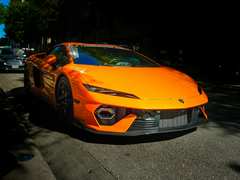
Pagani Utopia 2025: The Pinnacle of Hypercar Artistry and Uncompromised Performance
For over a decade, the automotive landscape has been a whirlwind of electrification, radical design, and technological leaps. Yet, amidst this relentless evolution, certain marques continue to champion the enduring allure of the internal combustion engine, meticulously crafting machines that defy convention and redefine automotive artistry. Pagani, a name synonymous with unparalleled craftsmanship and exhilarating performance, has once again raised the bar with its latest masterpiece: the Pagani Utopia 2025. This isn’t merely a successor to the legendary Huayra; it’s an evolution, a culmination of twenty-five years of obsessive pursuit of perfection, presenting a compelling argument for the ultimate hypercar formula.
As an industry veteran with a decade immersed in the intricate world of performance vehicles, I’ve witnessed firsthand the seismic shifts in automotive engineering. The siren song of electric power is undeniable, and its impact on the hypercar segment is profound. However, the Pagani Utopia 2025 serves as a potent reminder that the visceral, soul-stirring experience of a naturally aspirated or, in this case, a twin-turbocharged V12 engine remains an irreplaceable cornerstone of automotive passion. This £2.2 million marvel isn’t just about raw numbers; it’s about an experience, a meticulously choreographed ballet of engineering, art, and pure driving exhilaration.
The core of the Utopia’s sensational performance lies within its heart: an 852bhp, twin-turbocharged V12 engine, meticulously engineered by AMG. This isn’t just an engine; it’s a force of nature, a symphony of meticulously machined components designed to deliver relentless thrust. The magic truly unfolds when you engage a lower gear, perhaps third or fourth, at a modest 30mph. As you gently apply the throttle, there’s a momentary, almost anticipatory pause. Then, the V12 inhales deeply, transforming air into explosive energy. The sensation is akin to being gently but firmly embraced by an invisible hand, an intensifying longitudinal G-force that presses you deeper into the impeccably crafted seats. It’s not the jarring, immediate slam of some electric powertrains, but a more nuanced, evolving squeeze that elicits a primal, exhilarating response. The initial moments can be disorienting, triggering an almost involuntary recoil, followed by a rush of adrenaline, then uncontrollable giggles. The sheer, unadulterated joy of the Utopia’s ability to propel you towards the horizon with such ferocity never loses its appeal. While a simple in-gear acceleration run might seem a simplistic measure of its capabilities, it brilliantly encapsulates the elemental, raw appeal of this exquisite machine.
The name itself, “Utopia,” hints at a vision of perfection. Sir Thomas More’s 16th-century philosophical treatise envisioned an ideal society, an impossible dream. Horacio Pagani’s Utopia, however, is a tangible reality – albeit an unattainable one for most. This £2.2 million, 1280kg (dry weight) masterpiece, capable of a breathtaking 217mph, represents a triumph of advanced composites, exotic alloys, and an unwavering commitment to artistic expression. While More’s Utopia remained a literary concept, Pagani’s interpretation is a visceral, achievable, albeit exclusive, dream for the 99 fortunate individuals who have already secured their coupe build slots, with the Roadster variant also in high demand. For the rest of us, the Utopia remains a fleeting, vicarious reality, a chance to experience automotive perfection on the finest roads, perhaps within striking distance of Pagani’s San Cesario sul Panaro headquarters.
The scarcity of new Pagani models is legendary, a testament to the brand’s dedication to perfection. The Utopia marks only the third distinct model line to emerge from the Pagani atelier in over a quarter-century, following in the illustrious footsteps of the Zonda and the Huayra. The question is: has the wait been worthwhile?
My own journey with Pagani began nearly two decades ago, experiencing the nascent stages of their craft. The company then was a far cry from its current impressive stature. The original workshop, a modest space within the very building that now serves as the Art & Science Research Centre, was a hub of innovation. Today, the sprawling ‘Atelier’ – a breathtaking headquarters and museum opened in 2017 – houses not only car production but also the bespoke customization (Unico), personalization (Grandi Complicazioni), and restoration (Rinascimento) departments. It is within this temple of automotive artistry that the Utopia story truly unfolds.
My initial encounter with the Utopia was from the passenger seat, a privilege often reserved for the most trusted individuals. Riding alongside Pagani’s R&D test driver, Alberto Scilla, on the legendary Futa Pass – a route steeped in Mille Miglia history and a mere 90 minutes from Pagani’s base – offered a unique perspective. Even from this vantage point, the Utopia captivated. Its ride quality surprised me; it was far more supple than anticipated for a vehicle of such extreme performance. While the V12 engine’s presence was undeniable, it remained commendably subdued at lower speeds, a gentle giant waiting to be unleashed. This duality – road car refinement married with mind-bending performance – is a hallmark of Pagani’s philosophy.
Scilla articulated the immense effort poured into refining the manual transmission. For a car wielding 811 lb-ft of torque, developing a manual gearbox with the delicacy required to truly honor the traditional stick-shift experience is a monumental task. Yet, judging by Scilla’s seamless shifts, the Utopia achieves this with remarkable finesse, a testament to the engineering prowess involved. As we navigated the autostrada, the Utopia effortlessly carved through traffic, its presence commanding, parting the flow like a seasoned apex predator. Occasional, seemingly gratuitous downshifts and throttle applications unleashed a guttural roar from the V12, a richer, more resonant, and more aggressive symphony than its predecessor, the Huayra. It’s an engine that doesn’t just perform; it sings.
Upon stopping for fuel, the inevitable throng of admirers materialized, drawn by the sheer visual magnetism of the Utopia. Despite spending hours in its company, I too found myself mesmerized. The absence of overtly aggressive wings and massive venturi tunnels signifies a deliberate departure from the current hypercar trend obsessed with aerodynamic downforce. Instead, the Utopia embraces a more artistic, pure form, adorned with lavish embellishments and captivating flourishes. This unique fusion is the very essence of Pagani’s distinctive aesthetic.
The Utopia’s key, a weighty, perfectly sculpted puck, felt substantial in my hand. Yet, even with the coveted ignition sequence initiated, my gaze was inexorably drawn to its sculpted lines, its compound curves. Every piece of brightwork, both exterior and interior, is meticulously machined from solid billet, imbuing the car with a jewelry-like quality and the illusion of being hewn from a single, monolithic entity. Witnessing this craftsmanship in the real world is nothing short of remarkable.
The dihedral doors, a common supercar trope, swing upwards, revealing a cockpit that can only be described as an extraordinary testament to maximalist design. It’s a dazzling explosion of exquisite materials, intricate shapes, and audacious finishes. The familiar Pagani signatures are all present: the periscope air vents, the floating crescent instrument binnacle, the flawless exposed carbon fiber chassis, and the ingenious use of glazing that extends into the roof, flooding the cabin with light and creating an augmented sense of space.
True to its ethos, the Utopia celebrates mechanical artistry. The analogue instruments, a refreshing throwback, feature miniature portholes revealing their inner workings, reminiscent of the intricate mechanics of a fine Swiss watch. And then there’s the gear shifter, a sculpted masterpiece rising from the transmission tunnel, its complex linkage proudly displayed beneath. This dedication to beautifully engineered components stems from Pagani’s lifelong admiration for Leonardo da Vinci, who championed the inseparable link between art and science. The steering wheel exemplifies this philosophy: a single component born from a 43kg billet of high-grade alloy, undergoing 28 hours of five-axis machining to tolerances of just 0.5 microns, followed by meticulous hand-polishing, resulting in a mere 1.6kg finished product. The reclaimed 41.3kg of swarf is, of course, recycled – a nod to sustainable artistry.
Gone are the days of manual supercar clutches requiring Herculean effort. The Utopia’s clutch pedal is light and progressive, offering just enough resistance to feel mechanical, with a perfectly discernible bite point that makes pulling away a delight. The gearshift action is clean and precise, perhaps a fraction longer than some, but utterly satisfying. The inclusion of a dog-leg first gear adds a delightful touch of nostalgia, though the sheer tidal wave of torque available from tickover means pulling away in second is entirely feasible. The positive spring bias guiding the lever towards the center of the open gate ensures slick and precise upshifts into second and beyond, explaining why a remarkable 70% of Utopia customers opt for the manual transmission.
While proudly analogue in its presentation, the Utopia benefits from sophisticated, integrated electronics. A choice of dynamic modes – Comfort, Sport, Race, and Wet – allows for precise tuning of the car’s demeanor, complemented by a ‘Supersoft’ mode, akin to Ferrari’s bumpy road button, offering immediate access to the most compliant suspension setting. In truth, the need for this latter setting is rare, thanks to the exceptionally well-judged TracTive semi-active dampers, which strike an impressive balance between bump absorption and body control. Sport mode becomes my default, injecting a potent, yet controlled, dynamism without overwhelming the senses. The Electronic Stability Control (ESC) offers a reassuring, subtle hand, gently intervening on corner exits if one becomes overly ambitious with the throttle, yet allowing for blistering progress, especially once the 265/35 R21 front and 325/30 R22 rear Pirelli P Zero Corsas reach optimal temperature.
The allure of full Race mode, with its unleashed performance and more permissive ESC, is undeniable. However, the specter of explaining a costly encounter with Armco to Horacio Pagani looms large. A compromise is struck: Race mode engaged, but the ESC remains untouched. This proves to be the optimal strategy. Race mode unleashes the Utopia’s full potential, while the less intrusive ESC permits a delightful, controllable amount of rear-wheel slip, retaining a dependable safety net.
Accelerating through the gears in the Utopia is akin to riding a rocket. The AMG-derived V12, while not a high-revving screamer with a redline of 6700rpm, offers a rich tapestry of sound and sensation with each shift. Third and fourth gears become the sweet spot for spirited driving, with occasional forays into fifth and brief drops into second. In Race mode, the V12’s bellow intensifies, becoming harder and more guttural, punctuated by a delightful symphony of induction chuffs and turbo whistles as the throttle is modulated. The overrun is equally spectacular, with a deep, bass-heavy artillery barrage erupting from the Gatling-gun exhaust.
This raw, explosive power creates a fascinating juxtaposition with the Utopia’s seductive form and refined character. Yet, its precision, poise, and uncanny illusion of compactness are entirely contemporary. Older generations of large supercars often wore their unwieldiness as a badge of honor. However, the modern breed, exemplified by electrified marvels like the Lamborghini Revuelto with its torque vectoring, has irrevocably altered the game. Paganis have always possessed a genetic advantage: a chassis constructed from titanium-infused carbon fiber and a mechanical purity that negates the need for complex electronic solutions to manage mass. Despite its timeless objectives, the Utopia has seamlessly adapted to the modern era.
Power-to-weight ratios can be misleading. A 500bhp car weighing one ton offers the same numerical ratio as a two-ton car with 1000bhp, yet their driving experiences are worlds apart. The Utopia, weighing a mere 1280kg dry (1340kg wet) with its 852bhp, feels demonstrably more energized and alert than heavier, albeit numerically more potent, hypercars like the Pininfarina Battista or Bugatti Chiron. It possesses a fraction of their mass to propel, contain, and maneuver.
Navigating the challenging sections of the Futa Pass, this translates into colossal potency between corners, coupled with an eagerness to embrace braking zones and negotiate turns with exhilarating precision. The car feels natural, predictable, and remarkably exploitable, encouraging the driver to delve deeper into its prodigious performance reserves. The steering is light yet precise, with rapid responses yet sufficient composure to guide the Utopia to the apex with unwavering accuracy and confidence. The ability to precisely place the inside front wheel is uncanny. Initially, a desire for slightly more steering feedback might surface, but with experience, the Utopia’s focused approach, minimizing distraction, becomes evident. Combined with the light clutch, slick gearbox, and monumental powerplant, one doesn’t fight the Utopia; one finds harmony.
This harmony extends to the monumental 410mm front and 390mm rear Brembo CCM-R brakes. The colossal six-piston front and four-piston rear calipers apply progressive, relentless clamping force to the vast carbon rotors. Effortlessly modulated at low speeds, they offer immense bite at higher velocities, all delivered through a consistently firm pedal that inspires absolute confidence.
The true magic of the Pagani Utopia lies in its ability to transcend conventional hypercar doctrine. While undeniably powerful and breathtakingly fast, its name perfectly encapsulates its core philosophy: the pursuit of perfect harmony in all aspects, rather than prioritizing extreme performance at the expense of the overall experience. The marriage of the monumental twin-turbo V12 to the sweet-shifting manual gearbox is transformative. Similarly, the deliberate decision not to chase four-digit horsepower figures or stratospheric redlines results in a powertrain delivering eye-widening, and crucially, nuanced performance that excels on the road at all speeds. That it adheres to global emissions and homologation standards underscores Pagani’s meticulous approach and the invaluable partnership with AMG as its engine supplier.
While sophisticated electronics are often perceived as antithetical to organic, analogue driving experiences, the Utopia’s deft integration of adaptive damping, ESC, and electronic differential successfully refines and, when necessary, tames the machine, enhancing the feel and dynamism that discerning drivers crave.
The result is a savagely quick and sublimely sorted automobile. It effortlessly blends the purity and engagement of the Zonda with the epic scope and modern refinements of the Huayra, all while forging its own authentic character and distinct capabilities. The Utopia moves the game forward by adhering to its own unwavering principles: contemporary where it matters, yet timeless in its essence. Pagani has, once again, achieved automotive perfection.
For those captivated by the allure of open-top driving, the Pagani Utopia Roadster presents an even more compelling proposition. Unlike previous models, the coupe and Roadster designs were conceived concurrently, minimizing compromises. The dry weight remains identical at 1280kg, with Pagani’s unparalleled mastery of carbon fiber ensuring the bespoke tub retains exceptional rigidity without additional reinforcement. Like its coupe sibling, the Utopia Roadster boasts worldwide homologation for safety and emissions. While build numbers and price increase – with each of the 130 Roadsters commanding a price tag of £3.1 million, and production capped at between 50 and 60 units annually – the fundamental essence of the Utopia remains undiluted.
The Pagani Utopia 2025 isn’t just a car; it’s a statement. It’s a testament to the enduring power of mechanical artistry and the unwavering pursuit of automotive perfection. If you seek an unparalleled driving experience that engages all your senses, a machine that blurs the lines between art and engineering, then the Pagani Utopia is not merely a car to admire; it’s an experience to be pursued.
Embark on your own journey of automotive discovery. Explore the world of hypercars and discover the machines that ignite passion and redefine performance by contacting a specialist automotive consultant or visiting your nearest authorized Pagani dealership.


 Pagani Utopia 2025: The Pinnacle of Hypercar Artistry and Uncompromised Performance
For over a decade, the automotive landscape has been a whirlwind of electrification, radical design, and technological leaps. Yet, amidst this relentless evolution, certain marques continue to champion the enduring allure of the internal combustion engine, meticulously crafting machines that defy convention and redefine automotive artistry. Pagani, a name synonymous with unparalleled craftsmanship and exhilarating performance, has once again raised the bar with its latest masterpiece: the Pagani Utopia 2025. This isn’t merely a successor to the legendary Huayra; it’s an evolution, a culmination of twenty-five years of obsessive pursuit of perfection, presenting a compelling argument for the ultimate hypercar formula.
As an industry veteran with a decade immersed in the intricate world of performance vehicles, I’ve witnessed firsthand the seismic shifts in automotive engineering. The siren song of electric power is undeniable, and its impact on the hypercar segment is profound. However, the Pagani Utopia 2025 serves as a potent reminder that the visceral, soul-stirring experience of a naturally aspirated or, in this case, a twin-turbocharged V12 engine remains an irreplaceable cornerstone of automotive passion. This £2.2 million marvel isn’t just about raw numbers; it’s about an experience, a meticulously choreographed ballet of engineering, art, and pure driving exhilaration.
The core of the Utopia’s sensational performance lies within its heart: an 852bhp, twin-turbocharged V12 engine, meticulously engineered by AMG. This isn’t just an engine; it’s a force of nature, a symphony of meticulously machined components designed to deliver relentless thrust. The magic truly unfolds when you engage a lower gear, perhaps third or fourth, at a modest 30mph. As you gently apply the throttle, there’s a momentary, almost anticipatory pause. Then, the V12 inhales deeply, transforming air into explosive energy. The sensation is akin to being gently but firmly embraced by an invisible hand, an intensifying longitudinal G-force that presses you deeper into the impeccably crafted seats. It’s not the jarring, immediate slam of some electric powertrains, but a more nuanced, evolving squeeze that elicits a primal, exhilarating response. The initial moments can be disorienting, triggering an almost involuntary recoil, followed by a rush of adrenaline, then uncontrollable giggles. The sheer, unadulterated joy of the Utopia’s ability to propel you towards the horizon with such ferocity never loses its appeal. While a simple in-gear acceleration run might seem a simplistic measure of its capabilities, it brilliantly encapsulates the elemental, raw appeal of this exquisite machine.
The name itself, “Utopia,” hints at a vision of perfection. Sir Thomas More’s 16th-century philosophical treatise envisioned an ideal society, an impossible dream. Horacio Pagani’s Utopia, however, is a tangible reality – albeit an unattainable one for most. This £2.2 million, 1280kg (dry weight) masterpiece, capable of a breathtaking 217mph, represents a triumph of advanced composites, exotic alloys, and an unwavering commitment to artistic expression. While More’s Utopia remained a literary concept, Pagani’s interpretation is a visceral, achievable, albeit exclusive, dream for the 99 fortunate individuals who have already secured their coupe build slots, with the Roadster variant also in high demand. For the rest of us, the Utopia remains a fleeting, vicarious reality, a chance to experience automotive perfection on the finest roads, perhaps within striking distance of Pagani’s San Cesario sul Panaro headquarters.
The scarcity of new Pagani models is legendary, a testament to the brand’s dedication to perfection. The Utopia marks only the third distinct model line to emerge from the Pagani atelier in over a quarter-century, following in the illustrious footsteps of the Zonda and the Huayra. The question is: has the wait been worthwhile?
My own journey with Pagani began nearly two decades ago, experiencing the nascent stages of their craft. The company then was a far cry from its current impressive stature. The original workshop, a modest space within the very building that now serves as the Art & Science Research Centre, was a hub of innovation. Today, the sprawling ‘Atelier’ – a breathtaking headquarters and museum opened in 2017 – houses not only car production but also the bespoke customization (Unico), personalization (Grandi Complicazioni), and restoration (Rinascimento) departments. It is within this temple of automotive artistry that the Utopia story truly unfolds.
My initial encounter with the Utopia was from the passenger seat, a privilege often reserved for the most trusted individuals. Riding alongside Pagani’s R&D test driver, Alberto Scilla, on the legendary Futa Pass – a route steeped in Mille Miglia history and a mere 90 minutes from Pagani’s base – offered a unique perspective. Even from this vantage point, the Utopia captivated. Its ride quality surprised me; it was far more supple than anticipated for a vehicle of such extreme performance. While the V12 engine’s presence was undeniable, it remained commendably subdued at lower speeds, a gentle giant waiting to be unleashed. This duality – road car refinement married with mind-bending performance – is a hallmark of Pagani’s philosophy.
Scilla articulated the immense effort poured into refining the manual transmission. For a car wielding 811 lb-ft of torque, developing a manual gearbox with the delicacy required to truly honor the traditional stick-shift experience is a monumental task. Yet, judging by Scilla’s seamless shifts, the Utopia achieves this with remarkable finesse, a testament to the engineering prowess involved. As we navigated the autostrada, the Utopia effortlessly carved through traffic, its presence commanding, parting the flow like a seasoned apex predator. Occasional, seemingly gratuitous downshifts and throttle applications unleashed a guttural roar from the V12, a richer, more resonant, and more aggressive symphony than its predecessor, the Huayra. It’s an engine that doesn’t just perform; it sings.